
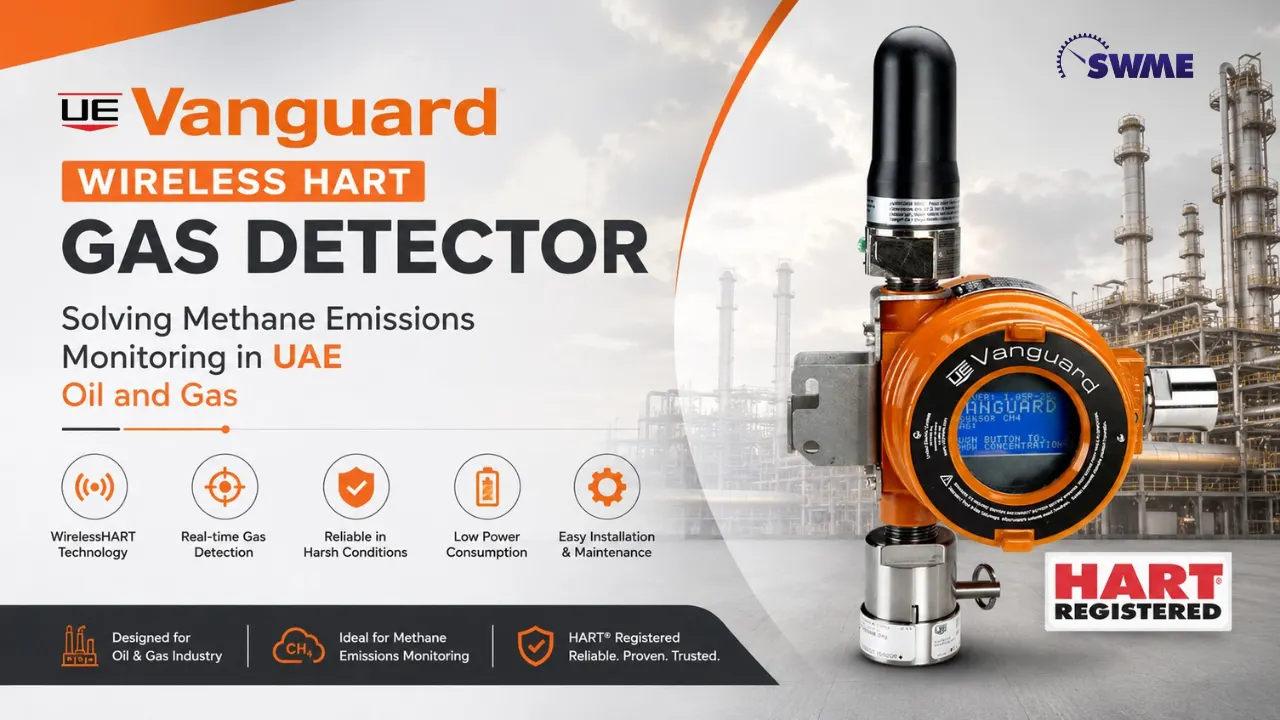
Vanguard Wireless HART Gas Detector: (Methane): An Innovative Solution to a Difficult Problem in Oil and Gas Emissions Monitoring
Natural gas is widely positioned as the bridge fuel between traditional fossil fuels and emerging renewable energy sources. But for natural gas to deliver on its promise of burning cleaner than coal and heavier hydrocarbons, less than 2 percent of it can leak from wellhead to burner tip. This is because the main component of natural gas — methane — is a potent greenhouse gas roughly 25 times stronger than carbon dioxide over a 100-year period.
For UAE and Gulf oil and gas operators, this creates a significant operational and regulatory challenge. With a dense network of wellheads, separation units, compressor stations, tank farms, and pipeline tie-ins spread across Abu Dhabi, Dubai, and the wider region, the scale of potential methane leak points is enormous. And yet, the traditional methods used to detect those leaks are expensive, infrequent, and fundamentally unable to provide continuous coverage.
This article explains why the United Electric Controls Vanguard WirelessHART gas detector represents a genuinely new approach to this problem, and why it is the solution SWME Control Systems Trading LLC recommends to UAE operators looking to improve their methane emissions programs.
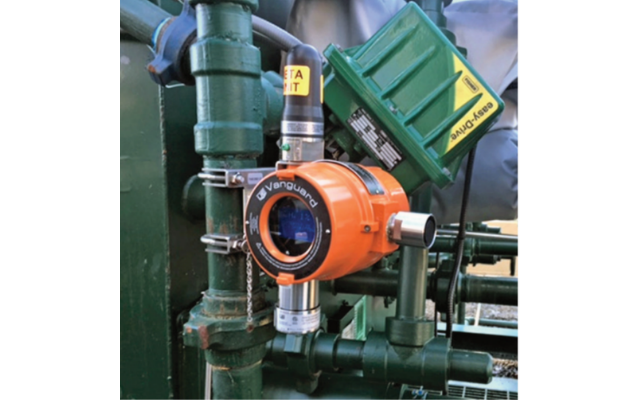
Vanguard WirelessHART gas detector mounted on a gas separation unit skid at a natural gas well pad
The Problem: Methane Leaks That Go Undetected for Too Long
The natural gas value chain is vast. From the wellhead through gathering systems, compression, processing, storage, and distribution, there are hundreds of thousands of potential leak points including flanges, valves, pump seals, compressor seals, and connecting pipework. The widely accepted reality is that a relatively small number of these points — often referred to as "super emitters" — account for more than 80 percent of all fugitive methane emissions, while representing less than 20 percent of the total leak source population.
Identifying and fixing those super emitters quickly is the key to meaningful methane reduction. But the traditional methods for finding them make this far harder than it needs to be.
Two methods dominate current methane detection programs across the Gulf and internationally: EPA Method 21, which requires a trained technician with a handheld gas analyzer to manually check every potential leak point, and Optical Gas Imaging (OGI), which uses infrared cameras to make gas leaks visible to a trained operator. Both methods share the same fundamental limitation: they require an expert on-site at scheduled intervals, not continuously.
A leak that begins between inspection visits may release significant volumes of methane before it is ever discovered. In a region like the UAE where many well sites and separation facilities operate with skeleton crews or are entirely unmanned, this gap between inspections represents a real and measurable risk to both the environment and to regulatory compliance.
Separating Leak Detection from Leak Location
The key insight that drives the Vanguard approach is the recognition that leak detection and leak location are two fundamentally different tasks, and that trying to do both simultaneously with expensive periodic surveys is what makes conventional programs so costly and ineffective.
Leak detection is the automated, continuous task of sensing whether gas concentration in the air has exceeded a threshold that indicates something is out of the ordinary. This is a task that modern industrial instrumentation can perform around the clock, at any distance, and over wireless networks — without a human present.
Leak location is the skilled, manual task of identifying exactly which valve, flange, or seal is the source of the emission once the automated system has raised an alert. This is the task that genuinely requires a trained expert with an OGI camera or handheld analyzer. And because it is non-repetitive and triggered rather than scheduled, the expert's time and cost are used far more efficiently.
By deploying continuous wireless gas detectors for detection and reserving OGI and Method 21 surveys for confirmed leak events, operators can dramatically reduce inspection frequency while improving overall detection coverage. This is the model the Vanguard WirelessHART gas detector is designed to enable.
Traditional Methods vs. Vanguard WirelessHART: A Direct Comparison
Traditional Wired and Manual Methods
- Periodic inspections — monthly, quarterly, or annual
- Leaks that occur between visits go undetected for weeks or months
- Requires trained expert on-site for every check
- Wired fixed point detectors cost up to USD 10,000 per point to install
- Not scalable — adding points means digging trenches and running conduit
- Cannot cover remote or unmanned wellsites economically
Vanguard WirelessHART Approach
- Continuous 24/7 monitoring at every detector location
- Alerts transmitted in real time to control room over existing WirelessHART network
- No expert required on-site until a leak is confirmed
- Installation costs up to 90% lower than equivalent wired system
- Battery powered — no power cable or signal conduit required
- Deployable at remote and unmanned sites in a single day
How the Vanguard WirelessHART Gas Detector Addresses These Challenges
The Vanguard WirelessHART gas detector from United Electric Controls was developed specifically in response to the limitations described above. It is a truly wireless, battery powered, fixed point gas detector that integrates into any existing WirelessHART network — the same open protocol already in use at most modern UAE oil and gas facilities through RTUs, DCS systems, and Emerson gateways.

United Electric Controls Vanguard WirelessHART Fixed Point Gas Detector
Because the Vanguard requires no power cable and no signal cable at the installation point, it can be mounted at or immediately adjacent to the components most likely to leak — flanges, valves, pump seals, compressor connections — rather than at fixed wired locations that may be meters away from the actual risk points. This dramatically improves the probability of early detection compared to conventional wired systems.
Key capabilities that make the Vanguard well suited to UAE methane monitoring programs include:
- Five year battery life — the longest in the industry for a fixed point wireless gas detector, reducing maintenance visits to remote sites
- WirelessHART mesh network communication — open protocol, interoperable with Emerson, Honeywell, and most other DCS and RTU platforms already deployed at UAE facilities
- Methane detection range 0 to 100% LEL using a non-dispersive infrared (NDIR) sensor — not affected by oxygen depletion and highly stable over time
- Patented FlexSense technology — sensors are hot-swappable and auto-configure, allowing the same transmitter to be redeployed for H2S, CO, NH3, or propane monitoring as applications change
- Wide ambient temperature range minus 40 to plus 65 degrees Celsius — covers the full range of UAE outdoor operating conditions across all seasons
- ATEX, IECEx, and cULus certified — approved for Zone 1 and Class I Div 1 hazardous areas across international and UAE markets
- IEC/EN 60079-29-1 certified — the first true wireless gas detector to earn this international gas detector performance standard, verified by TUV
- Universal mounting — pipe mount, magnetic I-beam mount, or adjustable universal clamp for 3 to 12 inch pipes, without hot work permits
Real World Deployment: Methane Detection at a Gas Separation Unit
A documented case study from United Electric Controls illustrates exactly how this model works in practice at a natural gas exploration and production site. The operator had well sites running with skeleton crews at locations remote from the central control center. One particular site had open path gas detectors deployed but had identified gaps in fixed point coverage around the leak-prone flanges and valves on a gas separation unit.
Deploying additional wired fixed point detectors would have required design work, conduit trenching, testing, and documentation — a timeline and cost that would have delayed other project activity. Instead, Vanguard WirelessHART gas detectors were strategically positioned around the identified leak-prone areas of the separation unit, creating a continuous detection envelope. Because the site already had a WirelessHART network through the ROC800 Remote Terminal Unit, the entire network was set up within one day. Ambient gas concentration data travels from the Vanguard mesh through the RTU and on to the central control center via cellular link.
During commissioning, a controlled release of natural gas from a valve was detected accurately by a neighboring Vanguard unit within 30 seconds. The operator now tracks fugitive methane emissions down to the component level from the distant control center — exactly the separation of detection and location that makes continuous wireless monitoring so powerful.
Why This Matters for UAE and Gulf Operators
The UAE's oil and gas sector is increasingly subject to ESG scrutiny from international investors, and ADNOC and independent operators across the Gulf are committing to methane emission reduction targets. The UAE has also ratified international frameworks that require demonstrated progress on fugitive emissions monitoring and reduction.
At the same time, many UAE onshore and offshore production facilities share the same characteristics that make conventional wired methane monitoring impractical: remote locations, large distances between assets, existing WirelessHART infrastructure from other instrumentation programs, and the practical impossibility of running conduit to every valve and flange worth monitoring.
The Vanguard WirelessHART gas detector addresses all of these constraints simultaneously. It provides continuous fixed point methane monitoring at a fraction of the cost of wired alternatives, integrates into existing site wireless networks, and enables UAE operators to separate the detection task from the location task — deploying skilled inspection resources only when and where they are genuinely needed.
Source the Vanguard WirelessHART Gas Detector in the UAE
As the authorized UAE distributor for United Electric Controls, SWME Control Systems Trading LLC supplies the full Vanguard range — including the TCD60 (Groups A, B, C, D) and TCD50 (Groups C, D) models — to customers across the UAE, Qatar, Oman, Kuwait, and Bahrain. We can assist with detector selection, sensor module selection for your target gas, WirelessHART network compatibility assessment, and commissioning support.
For full technical specifications and certifications, visit the Vanguard product page on the United Electric Controls website.
More Articles from SWME
Rugged capacitance level sensor ideal for oil, water and OEM applications across the Gulf.
KELLER Pressure Keller LEO2 Suppliers in UAE and Middle EastHigh accuracy digital pressure gauge for industrial calibration and field measurement across the region.
Dwyer Instruments Dwyer Magnehelic Gauge 2000 Suppliers in UAEReliable differential pressure gauge for HVAC, cleanrooms and industrial applications in UAE and Bahrain.
Dwyer Instruments Dwyer RHPX Humidity and Temperature Transmitter Suppliers in UAEHigh accuracy humidity and temperature transmitter for HVAC and cleanroom applications in the Gulf.


