
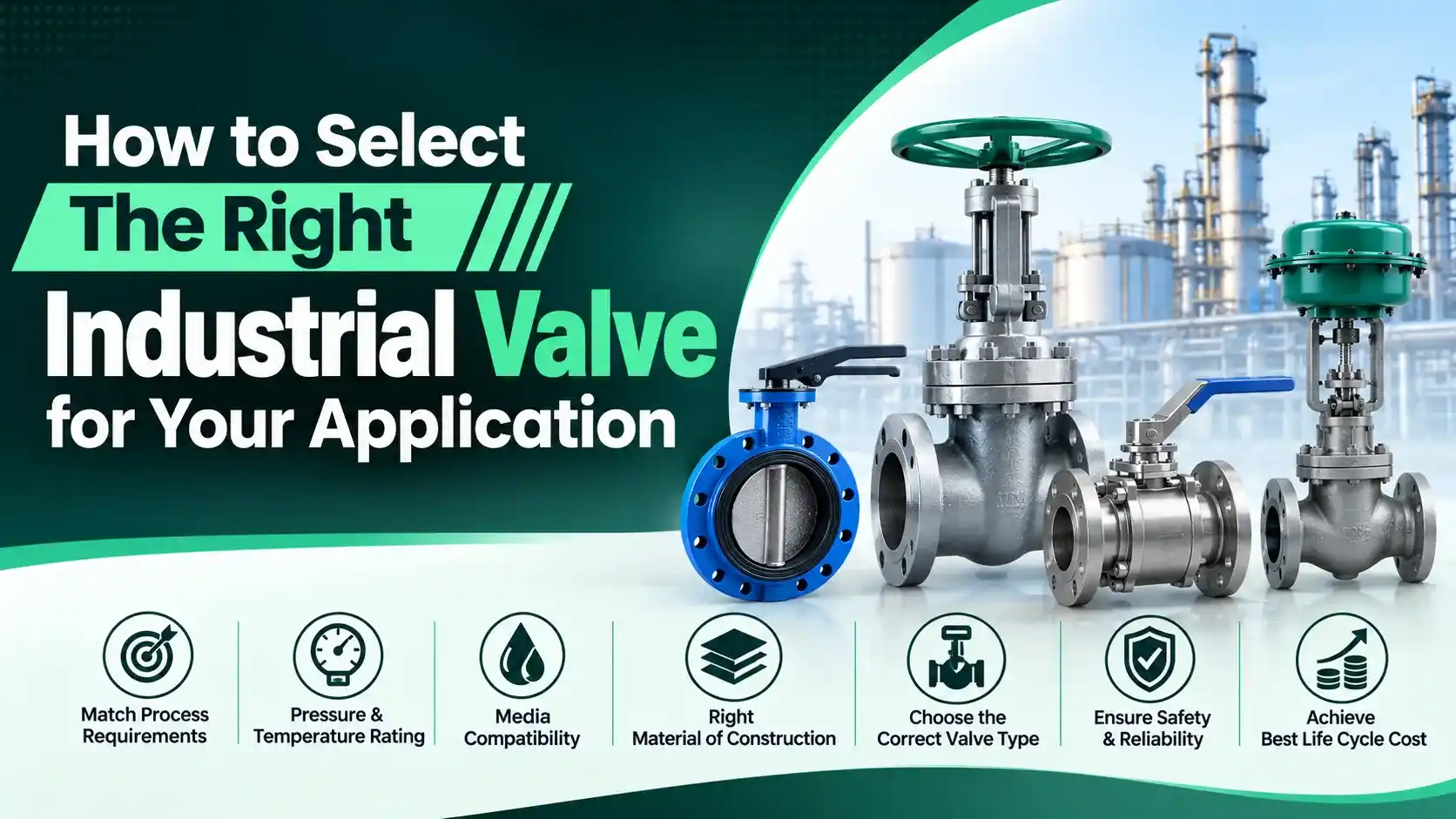
Industrial Valve Selection Guide for Your Application
How to select the right industrial valve? A valve looks like the simplest component on a process line, right up until the wrong one is installed. A ball valve throttled halfway open will wear its seat prematurely. A gate valve asked to control flow rather than simply isolate it will chatter and erode.
A check valve sized for the wrong flow direction will slam shut and hammer the pipeline every time the pump stops. Choosing the right valve type, material, and actuation method is not a minor detail, it is the difference between decades of reliable service and a costly early replacement.
This guide walks through how to think about valve selection from function first, covers the six valve types most commonly specified across UAE and Gulf process industries, and sets out the practical criteria that separate a correct specification from a guess.
Start With Function, Not Valve Type
Before comparing individual valve types, define what the valve actually needs to do on the line. Every industrial valve serves one of a few core functions, and that function narrows the realistic shortlist considerably before cost, material, or brand ever enter the conversation.
| Function | What It Means | Typical Valve Types |
|---|---|---|
| Isolation | Fully open or fully closed, no throttling in between | Ball, gate, plug |
| Throttling or Control | Precise, repeatable flow control across a range of positions | Globe, control valve, butterfly |
| Backflow Prevention | Allows flow in one direction only | Check valve, swing check, dual plate check |
| Pressure Regulation | Maintains downstream pressure within a set range | Pressure reducing valve, safety relief valve |
Six Common Industrial Valve Types at a Glance
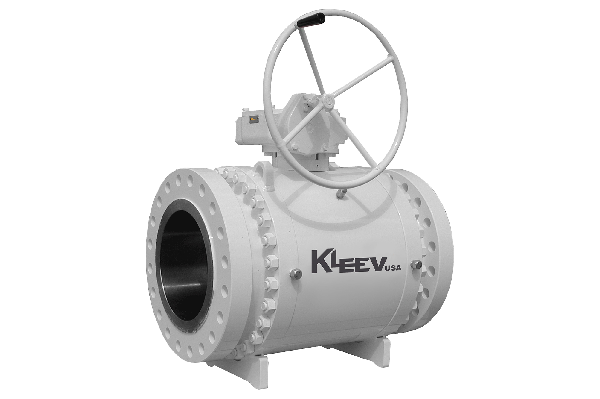
Ball Valve
Quarter turn shutoff with tight sealing and low pressure drop
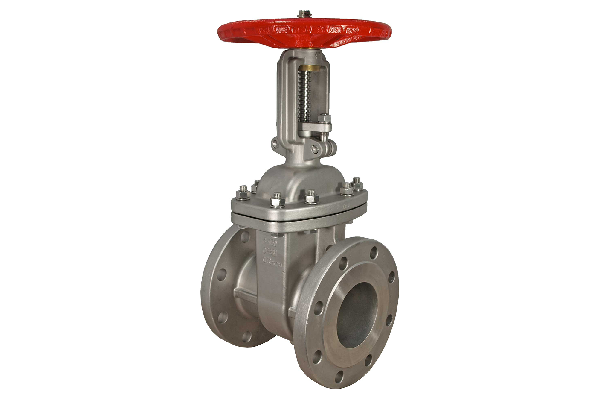
Gate Valve
Full bore isolation valve, not intended for throttling duty
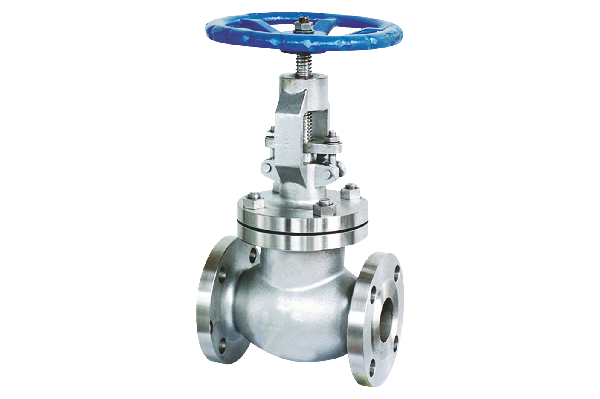
Globe Valve
Precise throttling with higher pressure drop than a ball valve
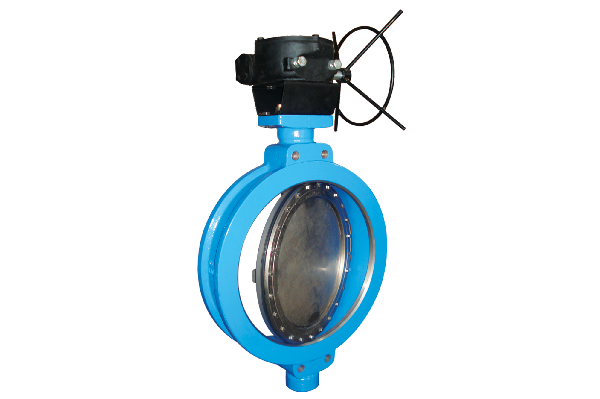
Butterfly Valve
Compact, lightweight throttling for large diameter lines
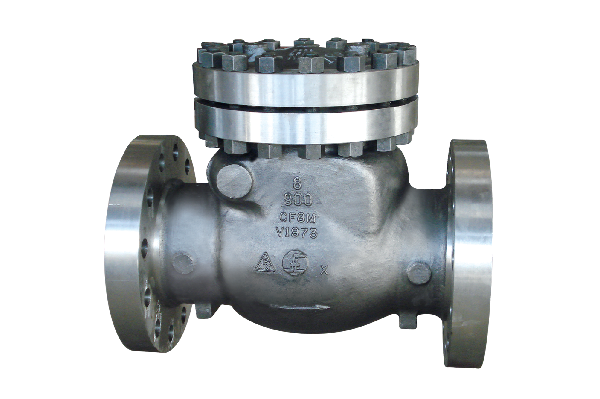
Check Valve
Allows flow in one direction only, preventing backflow
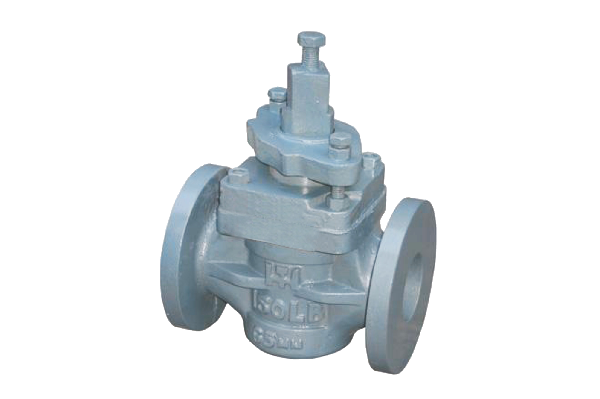
Plug Valve
Rugged quarter turn isolation for slurries and abrasive media
Simplified representations for reference. See our industrial valve range for full technical drawings and datasheets.
Comparing Valve Types by Flow Control and Pressure Drop
| Valve Type | Flow Control Ability | Pressure Drop | Best Suited For |
|---|---|---|---|
| Ball | Poor for throttling, excellent for on off duty | Very low when fully open | Fast, tight shutoff on clean to moderately dirty fluids |
| Gate | Not recommended for throttling | Low when fully open | Full bore isolation on pipelines and large diameter lines |
| Globe | Excellent, designed specifically for throttling | Higher due to internal flow path | Precise flow or pressure control |
| Butterfly | Good for moderate throttling | Moderate, depends on disc position | Large diameter lines where weight and cost matter |
| Check | No manual control, automatic operation only | Depends on type and design | Preventing backflow after pump shutdown |
| Plug | Fair, some designs allow limited throttling | Low to moderate | Slurries, abrasive, or high solids service |
Selection Criteria That Matter Most
1Fluid Characteristics
Viscosity, solids content, corrosiveness, and temperature all affect which valve type and trim material will hold up in service. A ball valve trapping solids in its cavity behaves very differently from a globe valve designed with a straighter flow path for the same duty.
2Pressure and Temperature Rating
Confirm the valve's pressure class and temperature rating cover both normal operating conditions and any expected upset conditions, not just the nominal process design point.
3Actuation Method
Manual valves suit infrequent operation where an operator is readily available. Pneumatic or electric actuators are worth the added cost where fast response, remote operation, or integration with a control system is required.
4End Connection Type
Flanged, threaded, welded, and wafer style connections each suit different pipe sizes, pressure ratings, and maintenance philosophies. Match the connection type to the surrounding piping specification early to avoid costly rework.
5Body, Seat, and Seal Material Compatibility
The wrong seat or seal material can fail within weeks in an aggressive chemical or high temperature service. Confirm compatibility with the specific process fluid, not just the general fluid category.
6Flow Characteristic for Control Duty
Control valves are available with linear, equal percentage, or quick opening flow characteristics. Matching the characteristic to the process control loop's behavior is essential for stable, accurate control rather than a valve that hunts or overshoots.
7Maintenance Access and Space Constraints
Consider how the valve will be maintained once installed. A compact butterfly valve may fit where a bulkier gate valve cannot, but it may also be harder to service in place depending on the actuator and gearbox arrangement chosen.
Manual Valves Versus Automated Valves
Manual valves remain the most economical choice for isolation points that are operated infrequently and where an operator can reach the valve safely. Automated valves, fitted with pneumatic or electric actuators, become the better investment once a valve needs to respond quickly to a process upset, operate remotely from a control room, or integrate with an emergency shutdown system, similar in principle to how electronic switches with local indication reduce the need for manual field checks elsewhere in a plant.
Typical Industrial Valve Applications in the UAE
- Wellhead and pipeline isolation using API 6A and API 6D gate valves
- Process control loops using globe and control valves in refineries and petrochemical plants
- Large diameter water and wastewater line isolation using butterfly valves
- Pump discharge backflow prevention using swing and dual plate check valves
- Slurry and mud handling in drilling operations using plug and mud valves
- Downstream pressure control at gas distribution stations using pressure reducing valves
Common Mistakes When Specifying Industrial Valves
Source Industrial Valves in the UAE and Gulf
SWME Control Systems Trading LLC supplies ball, gate, globe, butterfly, check, and control valves to industrial, oil and gas, and water treatment facilities across the UAE, Qatar, Oman, Kuwait, and Bahrain. Our range includes ball valves in forged, floating, and trunnion mounted designs, globe valves for precise throttling, and check valves in swing and dual plate configurations, alongside pressure reducing valves and stations.
For more background on valve selection and related instrumentation, browse our industrial valves overview or explore our full blog. To confirm the right valve type, material, and actuation for a specific duty, reach out through our contact page.


