
Table of Contents
- 1. RTD vs Thermocouple: Complete Selection Guide
- 1.1. How RTDs and Thermocouples Measure Temperature
- 1.2. RTD vs Thermocouple Comparision Side by Side
- 1.3. Where the Two Technologies Overlap and Where They Diverge
- 1.4. When an RTD Is the Better Choice
- 1.5. Selection Factors Specific to GCC High Temperature Applications
- 1.6. Typical High Temperature Applications Across the GCC
- 1.7. Common Mistakes When Selecting High Temperature Sensors
- 1.8. Source RTDs and Thermocouples in the UAE and Gulf
RTD vs Thermocouple: Complete Selection Guide
Ask ten process engineers across the GCC whether a duty needs an RTD or a thermocouple, and most will answer quickly, based on habit rather than a fresh look at the application. That instinct is often right, but high temperature duty in refineries, cement plants, power stations, and desalination facilities across the UAE and wider Gulf regularly sits right at the edge of where the usual rule of thumb stops applying cleanly.
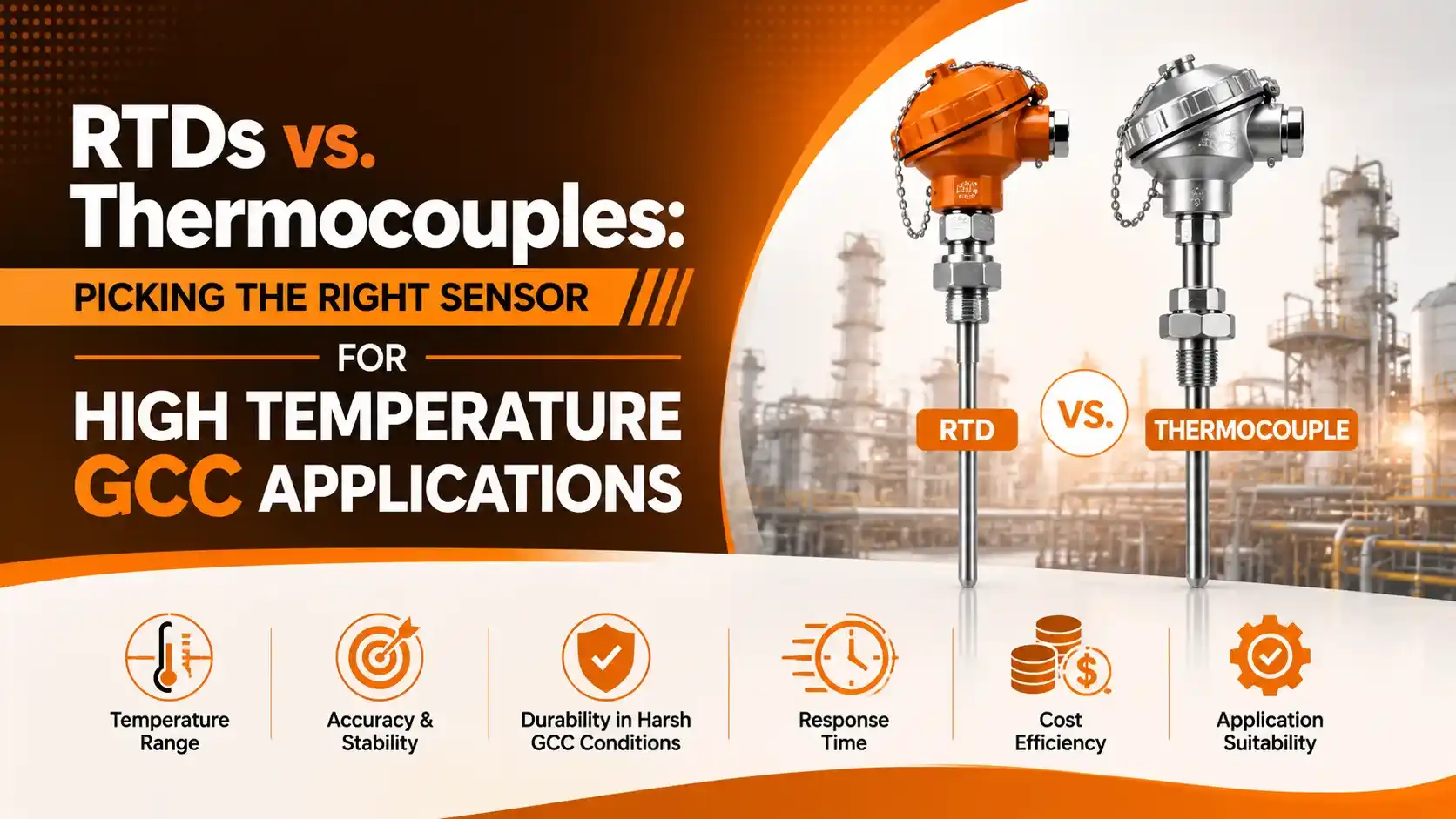
This guide walks through how RTDs and thermocouples actually differ, where each genuinely performs better at high temperature, and how to make the right call for a specific GCC process duty rather than defaulting to whichever sensor was specified on the last project.
How RTDs and Thermocouples Measure Temperature
A resistance temperature detector measures temperature through the predictable change in electrical resistance of a pure metal element, most commonly platinum, as its temperature rises. A thermocouple instead generates a small voltage at the junction of two dissimilar metals, with that voltage varying in a known way with temperature. The two technologies solve the same problem through entirely different physics, and that difference is exactly what drives their contrasting strengths at temperature extremes.
RTD vs Thermocouple Comparision Side by Side
| Property | RTD (Pt100) | Thermocouple |
|---|---|---|
| Typical Accuracy | 0.1 to 0.3°C | 0.5 to 2.0°C depending on type |
| Practical Range | Minus 200°C to around 850°C | Minus 200°C up to around 1750°C for type B, R, and S |
| Response Time | Slower, several seconds typical | Fast, well suited to rapidly changing process temperatures |
| Long Term Stability | Excellent, minimal drift over years | Gradual drift, particularly at sustained high temperature |
| Signal Type | Resistance, needs excitation current | Self generated millivolt signal |
| Vibration Tolerance | More fragile element, needs careful mounting | Generally more robust and tolerant of shock |
| Relative Cost | Higher initial cost | Lower initial cost, especially base metal types |
Where the Two Technologies Overlap and Where They Diverge
Approximate practical temperature ranges. Always confirm exact limits against the specific sensor grade, sheath material, and manufacturer datasheet.
When an RTD Is the Better Choice
Choose an RTD When
- Process temperature stays below roughly 600°C to 850°C
- High accuracy and long term stability matter more than raw temperature range
- The measurement feeds custody transfer, billing, or regulatory reporting
- The sensor will remain in service for years without frequent recalibration
Choose a Thermocouple When
- Process temperature regularly exceeds 850°C, as in kilns or furnaces
- Fast response to rapidly changing temperature is more important than absolute accuracy
- The installation is exposed to significant vibration or mechanical shock
- Budget or space constraints favor a smaller, lower cost sensor
Selection Factors Specific to GCC High Temperature Applications
Sustained Ambient Heat and Solar Loading
Outdoor installations across the Gulf routinely see ambient temperatures well above 45°C in summer, on top of the process temperature itself. Confirm the sensor housing, extension cable, and transmitter are all rated for the combined ambient plus process thermal load, not just the process temperature alone.
Vibration From Rotating and Combustion Equipment
Kilns, gas turbines, and large rotating machinery introduce sustained vibration that can fatigue a fragile RTD element over time. A well sheathed thermocouple, or an RTD in a robust thermowell assembly, is usually the safer choice in these environments.
Hazardous Area Classification
Refinery, gas processing, and petrochemical duty across the region frequently requires ATEX or IECEx certified sensor assemblies and transmitter housings. Confirm certification early in the selection process, since it can rule out otherwise suitable options.
Signal Cable Run Length
RTD signals are more sensitive to lead wire resistance over long cable runs unless a three or four wire configuration is used, while a thermocouple's millivolt signal is more tolerant of distance but more susceptible to electrical noise pickup near variable speed drives and large motors.
Calibration and Maintenance Access
RTDs hold calibration for far longer than thermocouples, which is valuable where the sensor sits somewhere difficult to reach, such as inside a kiln shell or deep within a process vessel where routine recalibration is impractical.
Typical High Temperature Applications Across the GCC
- Cement kiln shell and preheater tower temperature monitoring
- Refinery furnace and reactor temperature measurement
- Power plant boiler and flue gas temperature monitoring
- Desalination plant brine heater and evaporator stage temperature control
- Gas turbine exhaust and combustion chamber temperature monitoring
- Steel and aluminum processing furnace temperature measurement
Common Mistakes When Selecting High Temperature Sensors
Source RTDs and Thermocouples in the UAE and Gulf
SWME Control Systems Trading LLC supplies RTDs, thermocouples, and matching temperature transmitters to industrial, commercial, and utility facilities across the UAE, Qatar, Oman, Kuwait, and Bahrain. Our range extends from standard temperature transmitters to temperature switches for simpler alarm and trip duty, alongside instrumentation such as the Dwyer RHPX humidity and temperature transmitter for combined environmental monitoring.
Explore more application notes in our Temperature blog category, or browse the full blog. For help matching sensor type, sheath material, and certification to a specific process duty, reach out through our contact page.


