
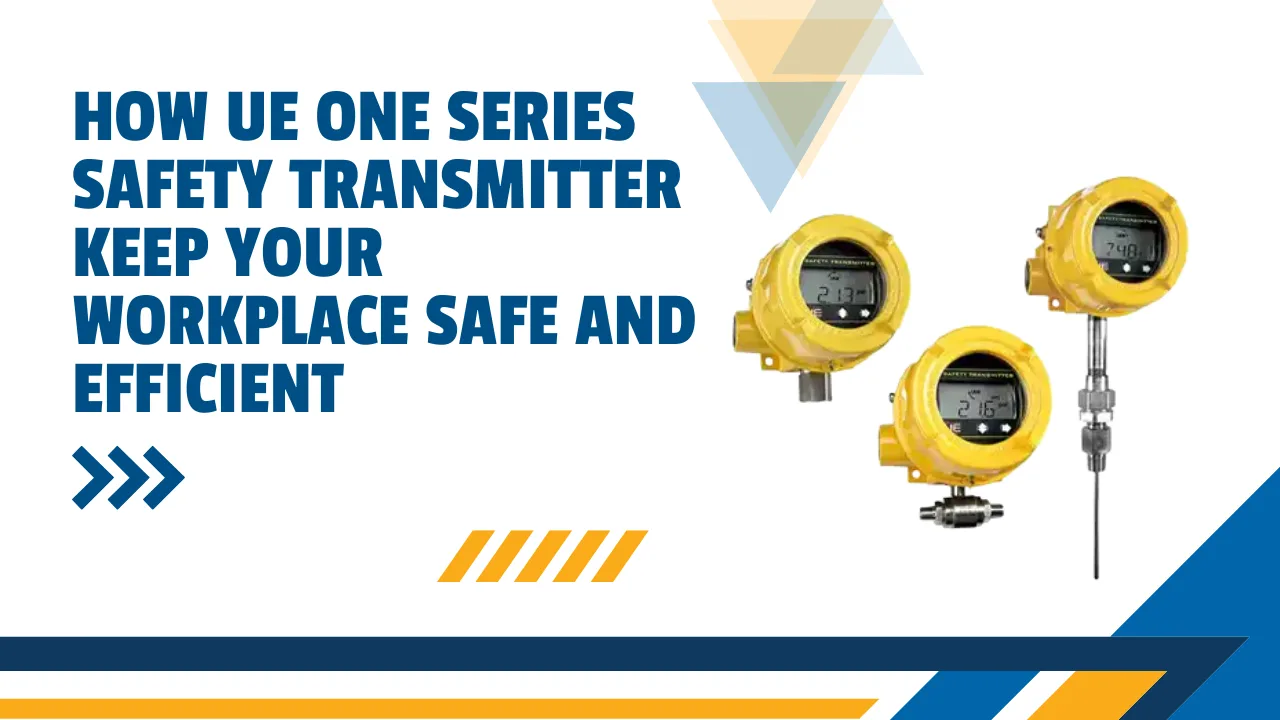
How UE One Series Safety Transmitter keep your workplace safe and efficient
Instrumented Protective Systems rely on field devices that measure a process variable and send that measurement to a logic solver. In most installations, the transmitter used for this purpose is an ordinary process transmitter, built on the same electronic architecture as every other transmitter from the same manufacturer.
This creates a specific risk. If a plant adds a second transmitter for redundancy, but that second transmitter shares the same design, the same components, and the same software, a single design defect or a single failure mode can affect both devices at once. Current safety standards, including IEC 61508, call this a common cause failure, and they require genuine design diversity to reduce it.
The United Electric Controls One Series Safety Transmitter was developed to address this requirement directly. This article explains how its design achieves diversity, independence, and simplicity, and what that means in practical terms for a safety instrumented function.
Common Cause Failure in Redundant Process Transmitters
A safety instrumented function is designed around a target failure probability. Adding a second, identical transmitter is a common way to reduce the probability that a single hardware fault will prevent the function from working when it is needed.
This approach only works if the two transmitters fail independently of each other. If both devices use the same sensor element, the same signal processing circuit, and the same firmware, a defect in the design, a manufacturing batch issue, or an environmental stress that affects one unit is likely to affect the other unit in the same way. Standards writers refer to this shared vulnerability using a beta factor, which quantifies the proportion of failures that are expected to affect redundant channels together rather than separately.
Reducing the beta factor requires genuine diversity between channels, not just a second copy of the same device. This is the specific gap the One Series Safety Transmitter is designed to close.
Design Diversity at the Component Level
The One Series Safety Transmitter builds diversity into its architecture at the board level, meeting the diversity provisions set out in IEC 61508. Diversity is applied down to the integrated circuit selection, the board layout, and the signal processing path for the sensor output.
This matters because a safety instrumented system is only as strong as its weakest shared component. Our guide to pressure measurement in hazardous areas covers a related principle, where instrument certification and construction detail determine whether a device is actually suitable for the protective duty assigned to it.
Component level diversity also supports automatic self diagnostics. The transmitter continuously checks its own internal parameters against expected values, and it can identify a developing fault before that fault causes the transmitter to report an incorrect process value.
Independent Failure Mode and Diagnostic Analysis Results
A Failure Mode, Effects, and Diagnostic Analysis, commonly abbreviated as FMEDA, is a structured engineering study. It works through every component in a device, identifies how that component can fail, and calculates what proportion of possible failures the device can detect on its own through internal diagnostics.
The result of this analysis is expressed as a Safe Failure Fraction, or SFF, which is the proportion of failures that are either safe by nature or detected by diagnostics before they can cause a dangerous undetected state. A higher SFF supports a higher safety integrity level for a given hardware architecture under IEC 61508.
| Metric | One Series Safety Transmitter | Typical Competing Transmitters |
|---|---|---|
| Safe Failure Fraction | 98.8% | Reported significantly lower in comparable FMEDA studies |
| Internal Fault Detection Time | 6 seconds, worst case | 30 minutes to over an hour, worst case |
| Self Test Interval | Every 6 seconds, automatic | Varies, often dependent on manual proof testing |
| Product and Safety Manual Length | Approximately 40 pages | Approximately 240 pages in some competing devices |
The transmitter runs a complete internal scan for faults and out of specification parameters on its own every 6 seconds. This reduces reliance on a technician catching a developing problem during a scheduled proof test, and it shortens the window during which an undetected fault could remain in the system.
Redundant Signal Paths Through Independent Outputs
The One Series Safety Transmitter provides both an analog output and a digital output from a single sensing element. This is a different form of redundancy from adding a second physical transmitter, but it still improves independence in how the process variable reaches the logic solver.
The digital signal can report a discrete state based on a programmed setpoint, effectively performing the trip decision inside the transmitter and communicating the result to the PLC directly. The analog output can run in parallel, giving the PLC a continuous view of the process variable through a separate signal path. If one output path is affected by a wiring fault or an interface issue, the other path can still provide useful information to the control system.
Onboard Safety Relay Output and Independent Protection Layers
The transmitter includes an onboard Safety Relay Output that can act directly on a final element, such as a valve actuator or a motor start and stop circuit, without waiting for the PLC to process the trip. This is the same direct acting principle discussed in our article on pump protection using pressure, flow, and temperature instruments, where a fast, local trip path reduces the time between a dangerous condition developing and the final element responding.
Removing the PLC from the direct trip path also removes one shared component between the sensing function and the final trip action, which supports the kind of layer of protection analysis used to justify an Independent Protection Layer under IEC 61511. The PLC still receives status information through the transmitter's analog output, so operators retain visibility into how the device is performing even though the PLC is no longer in the critical trip path itself.
Documentation and Functional Safety Management
IEC 61508 places explicit requirements on functional safety management, including the documentation used during specification, installation, and proof testing. Long, complex manuals increase the chance that a technician misses a step or misinterprets an instruction during commissioning or maintenance.
The One Series Safety Transmitter is supported by a combined product and safety manual of approximately 40 pages, compared with approximately 240 pages for some competing devices covering similar functionality. A shorter, more direct manual reduces the burden on functional safety management procedures and supports faster, more consistent proof testing across a plant's maintenance team.
Typical Safety Instrumented Functions in the UAE
- Emergency shutdown systems in refineries and gas processing plants
- High integrity pressure protection systems on wellheads and pipelines
- Fire and gas system pressure and temperature monitoring loops
- Boiler and turbine protection systems in power generation plants
- Compressor and pump safety instrumented functions in petrochemical facilities
- Independent protection layers specified alongside a plant's basic process control system
Sourcing UE One Series Safety Transmitter in the UAE and Gulf
SWME Control Systems Trading LLC supplies the United Electric Controls One Series Safety Transmitter to industrial, oil and gas, and power generation facilities across the UAE, Qatar, Oman, Kuwait, and Bahrain.
Our application engineers can help specify output configuration, safety relay wiring, and certification requirements for a given safety instrumented function. For readers evaluating related United Electric Controls devices, our earlier article on the United Electric Controls One Series electronic switch covers a related product built for local indication and switching duty rather than full safety loop integration.
To discuss a specific safety instrumented function or request a quotation, contact our team through the contact page.


