Key takeaways
- A gate valve is an isolation valve: it should be either fully open or fully closed.
- A globe valve is built for throttling and can hold any position between open and closed.
- Gate valves have a straight bore and very low pressure drop; globe valves turn the flow and lose more pressure.
- Gate valves are usually bidirectional, while most globe valves have a flow arrow on the body.
Gate and globe valves look similar from the outside. Both have a handwheel, a rising stem and a linear closing element. Inside, however, they are built for very different jobs, and the gate valve vs globe valve choice decides whether a line isolates cleanly or controls flow smoothly.
This guide compares the two designs in plain terms. SWME supplies gate valves and globe valves for Oil and Gas, Petrochemical, Water and Utilities projects across the GCC. For an overview of all designs, see our guide to types of industrial valves.
In this guide
How Each Valve Works
Gate valve
A flat or wedge shaped gate moves up and down at right angles to the flow. When the gate is lifted, the bore is clear and the fluid passes straight through. When it is lowered, the gate seals against two seats. Because the flow path does not change direction, pressure loss in the fully open position is very low.
Globe valve
A disc moves onto a seat that sits across the flow. An internal wall forces the fluid to turn and pass through the seat opening, so the path is S shaped. The gap between disc and seat sets the flow rate, which is why a globe valve can throttle. In addition, the closing force acts directly on the disc, which gives very good shut off.
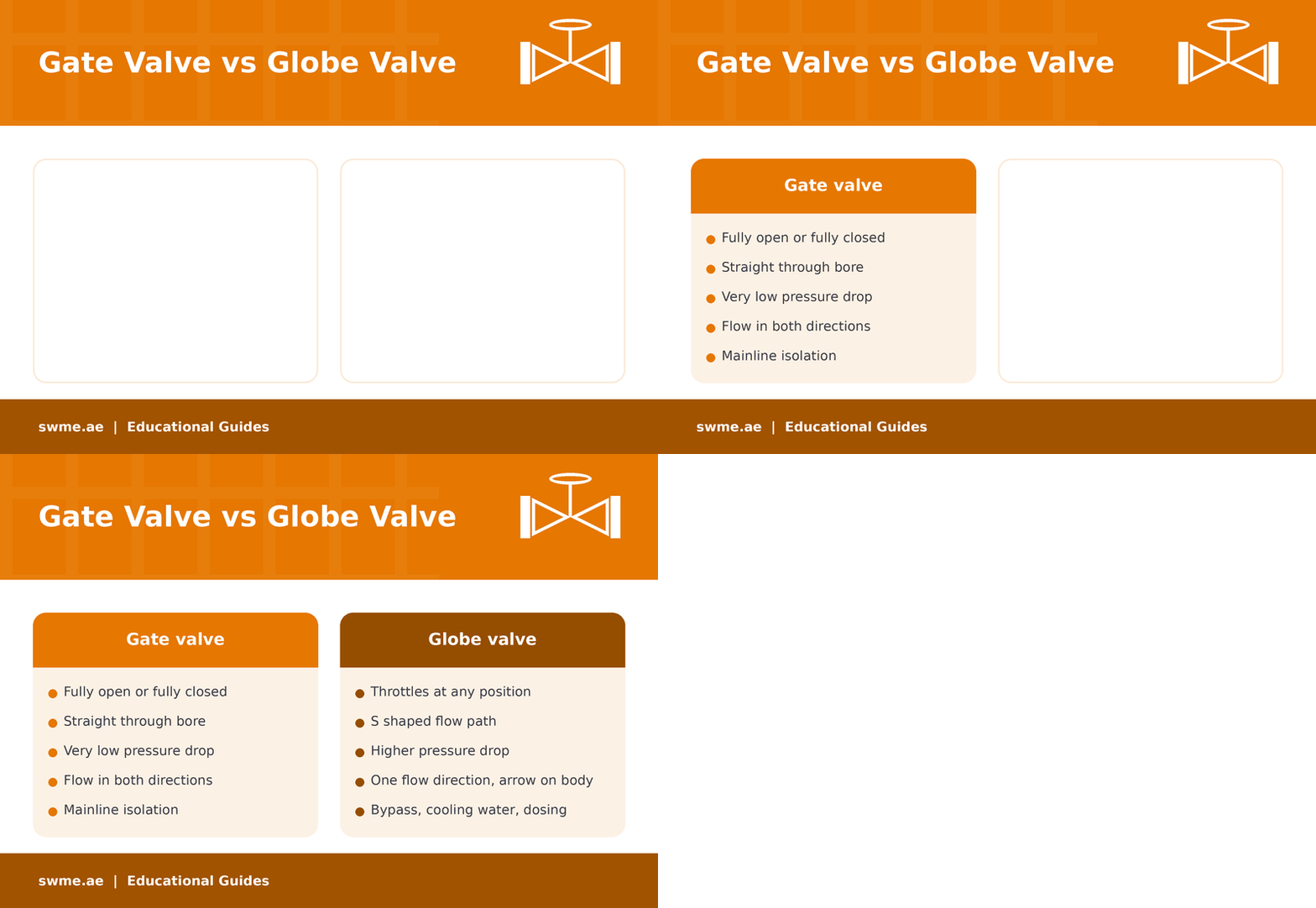
Gate Valve vs Globe Valve Comparison
| Feature | Gate valve | Globe valve |
|---|---|---|
| Main function | On and off isolation | Throttling and flow regulation |
| Flow path | Straight through | Turns through the seat (S shaped) |
| Pressure drop when open | Very low | High |
| Throttling | Poor, causes seat erosion | Excellent |
| Flow direction | Bidirectional | Unidirectional, arrow on body |
| Shut off | Good, metal wedge on seats | Very good, disc on seat |
| Weight and cost | Lighter and lower cost | Heavier and higher cost |
| Typical services | Mainline and equipment isolation | Cooling water, steam bypass, chemical dosing |
Both designs can be operated by handwheel, gearbox, pneumatic or electric actuator. When a line needs automatic control rather than manual throttling, a pneumatic control valve is usually the better choice.
Throttling and Pressure Drop
Pressure drop is the price of control. The straight bore of a gate valve wastes very little energy, which matters on long pipelines and large pump discharge lines. A globe valve turns the flow and loses more pressure, but that same restriction is what makes accurate throttling possible.
Globe valves come in three body patterns. In the T pattern, also called the Z body, the flow follows the S shaped path shown above. The Y pattern has the lowest pressure drop of the globe types but is the least efficient at throttling. The angle pattern turns the flow through 90 degrees. To estimate the energy lost across valves and fittings, use the minor losses calculator or the Darcy Weisbach head loss calculator.
Did you know?
A gate valve left a few turns open is one of the fastest ways to destroy it. High velocity flow under the gate cuts grooves in the seats and wedge, a type of damage called wire drawing. Once the seats are cut, the valve no longer isolates, even when it is fully closed.
Standards and Typical Sizes
Pressure class must always match the piping class of the line. For a wider look at the selection process, read our blog on how to select the right industrial valve.
How to Choose Between Them
Choose a gate valve when
- The valve will stay fully open or fully closed.
- Low pressure loss matters, for example on mainlines.
- Flow may run in both directions.
- The line size is large and weight and cost matter.
Choose a globe valve when
- Flow must be adjusted or throttled by hand.
- Tight shut off with frequent operation is needed.
- The service is steam, cooling water, bypass or dosing.
- A higher pressure drop is acceptable.
Clean fluid protects both valve types. Fit strainers upstream to keep weld debris and scale off the seats. When a control valve replaces a manual globe valve, size it with the Kv and Cv calculator and check the valve authority.
Common Mistakes to Avoid
Frequently Asked Questions
Can a gate valve be used for throttling?
No. A gate valve should be fully open or fully closed. Partial opening causes vibration and wire drawing of the seats.
Is a globe valve bidirectional?
Most globe valves are designed for one flow direction, which is marked with an arrow on the body.
Which valve has the lower pressure drop?
The gate valve. Its straight bore gives almost no restriction when fully open, while a globe valve turns the flow through the seat.
