Key takeaways
- A magnetic level gauge shows level with coloured flags that flip as a magnetic float moves inside a sealed chamber.
- The process liquid never touches the indicator, so there is no glass to break or leak.
- Switches and transmitters can be clamped onto the chamber for alarms and remote readings.
- The float must be designed for the liquid density, pressure and temperature.
A magnetic level gauge is a safe and reliable way to show liquid level in tanks, boilers and pressure vessels. It replaces traditional sight glasses on many Oil and Gas, Petrochemical and Utilities projects, because the liquid stays inside a sealed metal chamber.
This guide explains how the gauge works, how to add switches and transmitters, and what to specify. SWME supplies magnetic level gauges together with matching level switches and level transmitters.
In this guide
How a Magnetic Level Gauge Works
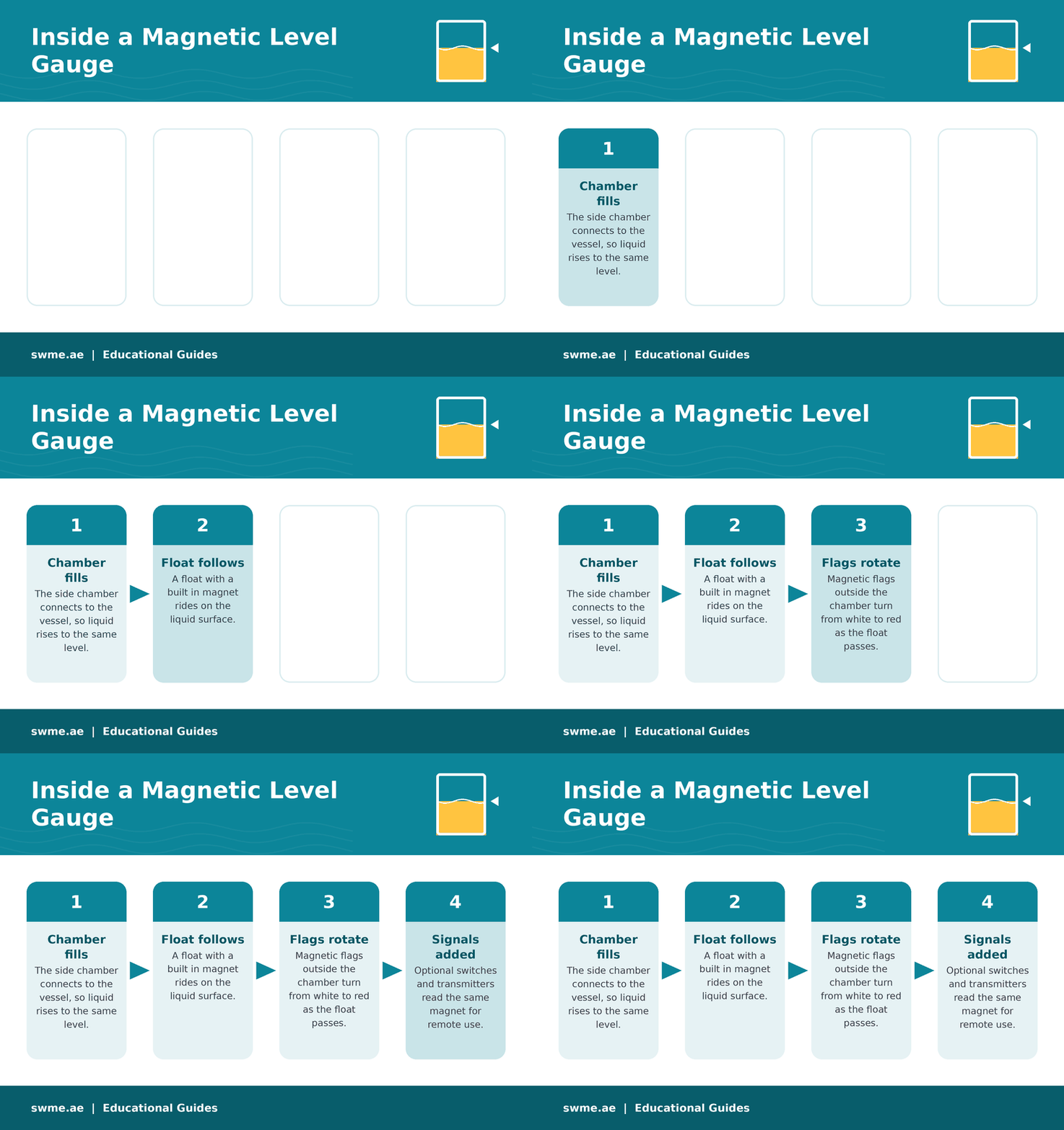
The gauge is a vertical chamber connected to the vessel at top and bottom. Because of the principle of communicating vessels, the liquid in the chamber rises to the same level as in the vessel. Inside the chamber is a float with a ring of permanent magnets.
Outside the chamber is an indicator rail with small flags or rollers. Each flag has a magnet and two coloured faces, usually red and white. As the float rises, its magnetic field flips the flags from white to red. The red column then shows the liquid level from a distance, even in poor light.
Did you know?
The float in a magnetic level gauge is sized for one specific density. For example, a float designed for water at 1.0 kg/L may sink in a light hydrocarbon at 0.6 kg/L. Always give the supplier the minimum density at operating temperature. The API gravity calculator helps convert oil gravity to density.
Main Components
Adding Switches and Transmitters
One advantage of a magnetic level gauge is that you can add remote signals without new vessel nozzles. Devices clamp onto the outside of the chamber and use the same float magnet.
Level switches
- Reed or bistable switches clamped at alarm points.
- High, low, high high and low low alarms.
- Adjustable position along the chamber.
Level transmitters
- Reed chain or magnetostrictive transmitters.
- 4 to 20 mA output with optional HART.
- Magnetostrictive versions offer high resolution.
When you scale the transmitter, the 4 to 20 mA scaling calculator converts current to level, and the horizontal tank volume calculator converts level to volume for drums and bullets.
Magnetic Level Gauge vs Sight Glass
| Feature | Magnetic level gauge | Glass sight gauge |
|---|---|---|
| Liquid contact with window | No | Yes |
| Breakage and leak risk | Very low | Higher |
| Visibility from distance | Excellent, bright colours | Poor with dirty glass |
| Toxic or flammable media | Suitable | Often not allowed |
| Remote signal options | Clamp on switches and transmitters | Limited |
| Maintenance | Low | Regular glass cleaning and replacement |
How to Specify a Magnetic Level Gauge
- Process data. Liquid, minimum density, operating and design pressure and temperature.
- Center to center distance. Distance between top and bottom process connections.
- Connections. Flange size, rating and orientation, such as side and side or top and bottom.
- Materials. Chamber and float materials suitable for the medium, such as 316L or titanium.
- Indicator. Flags or roller, scale units and colour.
- Accessories. Switches, transmitters, insulation, heat tracing and frost extensions.
For interface measurement, such as oil over water, the float can be weighted to sink through the light layer and sit on the heavy layer. For other technologies, read radar vs ultrasonic level measurement or browse the level measurement articles on instrumentationblog.in.
Common Mistakes to Avoid
Good calibration practice applies here too. See level transmitter calibration mistakes for common pitfalls with clamp on transmitters.
Frequently Asked Questions
Does a magnetic level gauge need power?
No. The flag indicator works purely by magnetism. Only optional switches and transmitters need wiring.
Can it measure the interface between two liquids?
Yes. A float weighted for the density difference rests on the interface between the light and heavy liquids.
How accurate is a magnetic level gauge?
The visual indicator typically resolves to about 5 to 10 mm. Clamp on magnetostrictive transmitters can achieve 1 mm or better.
