Key takeaways
- A check valve lets fluid flow one way; forward flow opens it and reverse flow returns the disc to its seat.
- Cracking pressure is the minimum upstream pressure at which the valve opens, and it varies with design and size.
- Swing checks have low pressure drop but can slam; dual plate and tilting disc checks close faster and cause less water hammer.
- Orientation and sizing also matter: an oversized check flutters and wears.
Every pump discharge and many process lines need protection against reverse flow. A check valve gives that protection with no actuator. SWME supplies check valves alongside our wider range of industrial valves for oil, gas, water and process plants in the UAE.
In this guide
How a Check Valve Works
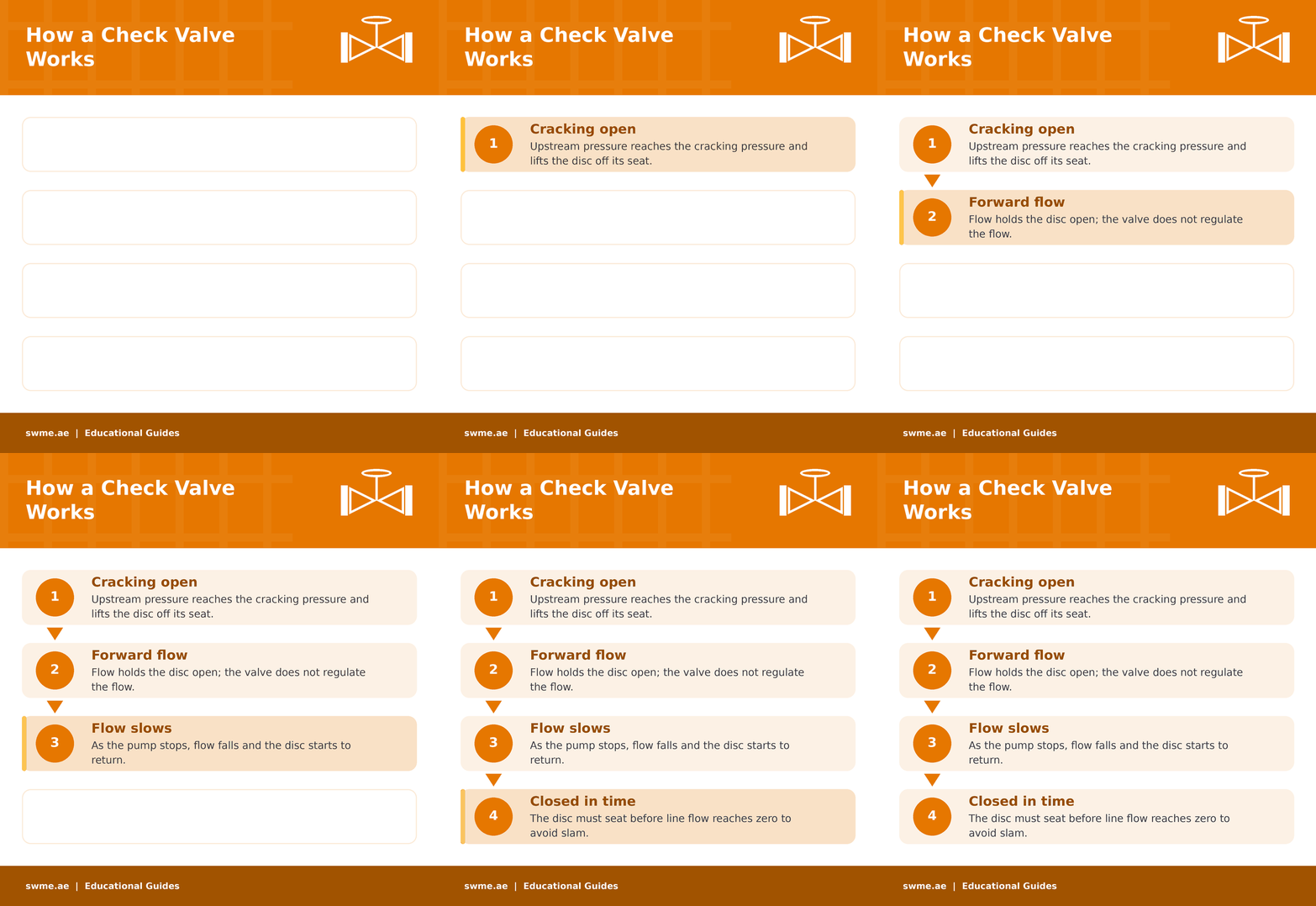
According to Projectmaterials, forward flow pushes the closing element off its seat and reverse flow pushes it back. Check valves do not regulate flow. Pumps and Systems defines cracking pressure as the minimum upstream pressure at which the valve opens, and stresses that the valve must be fully closed before line flow reaches zero.
Check Valve Types
| Type | How it closes | Notes from the sources |
|---|---|---|
| Swing | Hinged disc swings onto the seat | Low pressure drop; install horizontal or slightly sloping; main weakness is slam |
| Lift (piston) | Piston or disc lifts vertically off the seat | Higher pressure drop; suits pulsating flow such as reciprocating compressor discharge |
| Ball | Free ball rolls onto the seat | Suits viscous fluids; a free floating ball needs vertical flow up |
| Dual plate (wafer) | Two spring loaded half plates on a central pin | Compact for tight spaces; works horizontal and vertical |
| Tilting disc | Disc pivots off centre with short travel | Opens at low flow; suits low and pulsating flow and pump discharge |
| Silent and nozzle | Spring driven axial disc with minimum travel | Fastest closure; silent checks have higher pressure drop, nozzle checks lower head loss but not for suspended solids |
A stop check is a swing type body with a stem and handwheel that can force the disc shut, giving positive isolation in one body. The pressure drop ranking in the Projectmaterials overview is low for swing and tilting disc, medium for dual plate and ball, and medium to high for lift checks. For how check valves fit among other valve families, see types of industrial valves.
Slam and Water Hammer
Pumps and Systems says swing checks are highly susceptible to water hammer when the disc slams shut. Projectmaterials says dual plate and tilting disc check valves close faster and generate less water hammer, because the springs snap the plates shut before the fluid column builds momentum.
Ways to reduce slam
The water hammer calculator estimates the surge when flow stops suddenly, and the pipe flow velocity calculator checks line velocity.
Did you know?
MSS SP 92 asks for a check valve to sit at least five pipe diameters downstream of an elbow and ten diameters downstream of a tee or control valve.
Check Valve Standards
Selection Checklist
- Line size and orientation. Pumps and Systems prefers horizontal installation where possible; avoid swing checks in vertical upflow.
- Speed of flow reversal. Where flow reverses quickly, the faster closing dual plate, tilting disc or silent checks suit better.
- Fluid. For dirty or abrasive service, consider a swing check with an external lever and spring, or a duckbill.
- Pressure and temperature. Pick the class from ASME B16.34; Projectmaterials notes pressure seal bonnets above about Class 900.
- Sizing. Size from the manufacturer flow curve or Cv, not the line size. Try the Kv and Cv calculator.
- End connection. Wafer, flanged or butt welding ends to suit the line.
Common Mistakes to Avoid
For valve choice in general, read our post on how to select the right industrial valve and the guide to gate valve vs globe valve. For pump protection, see pump protection instruments.
Frequently Asked Questions
What is cracking pressure?
The minimum upstream pressure at which a check valve opens. It depends on the valve design and size.
Which check valve causes the least water hammer?
Dual plate, tilting disc and silent checks close faster than swing checks and generate less water hammer.
Can a check valve be installed vertically?
Some can. Dual plate checks work in vertical lines, a ball check needs flow up, and swing checks should stay horizontal.
