Key takeaways
- Good gas detector placement depends on gas density, leak sources, airflow and people.
- Heavy gases collect low, light gases rise, and gases similar to air follow the airflow.
- Detectors belong near likely leak points and where people work or breathe.
- A documented placement study, often using gas dispersion modelling, gives the best coverage.
Even the best sensor cannot warn of a leak if the gas never reaches it. That is why gas detector placement is as important as choosing the right technology. Detectors in the wrong place give a false sense of safety.
This guide explains the main factors that decide where fixed detectors should go. SWME supplies fixed and wireless gas detectors and supports clients with selection for Oil and Gas, Petrochemical and Utilities facilities.
In this guide
Factors That Decide Placement
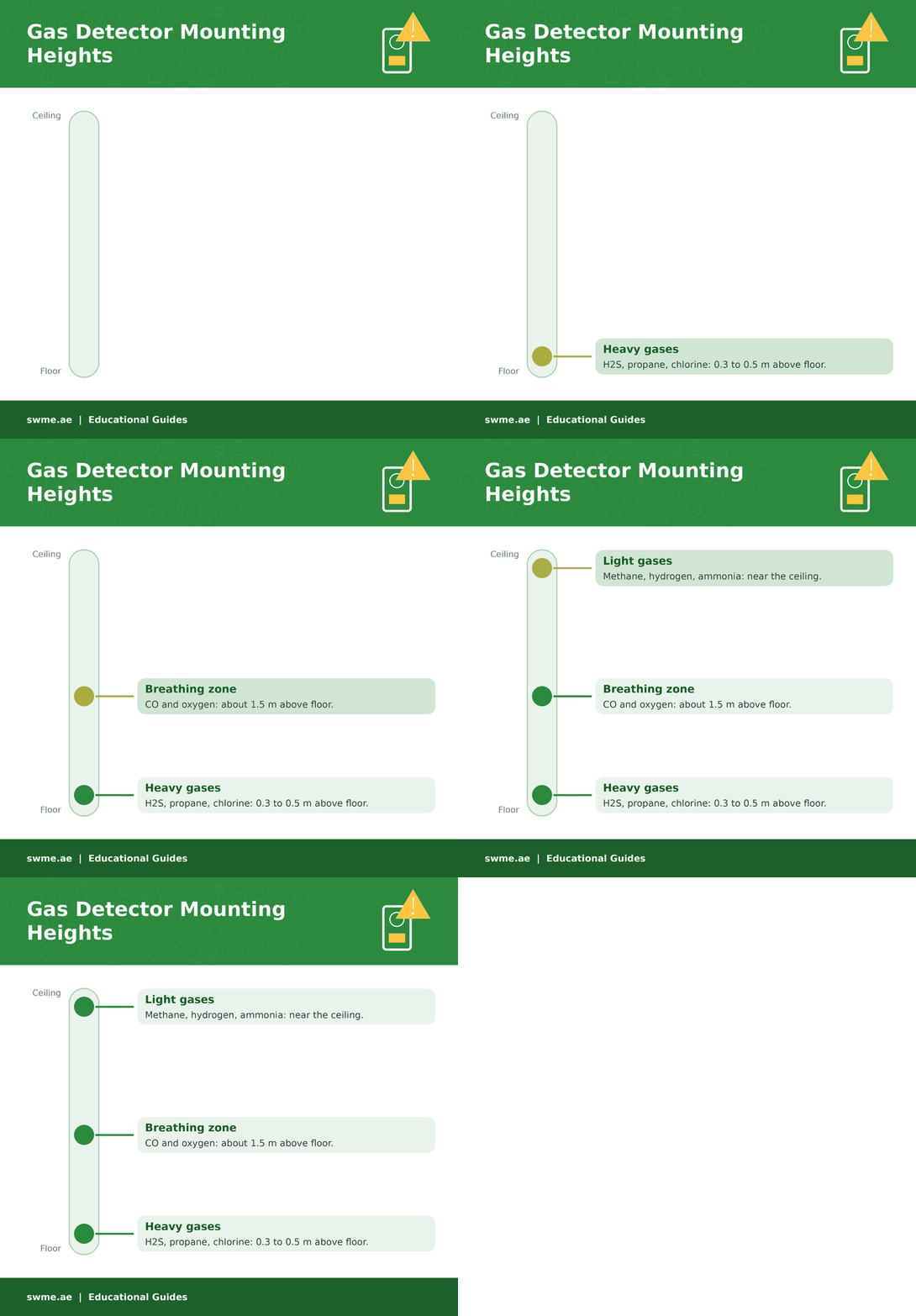
Mounting Height by Gas
| Gas | Relative density (air = 1) | Mounting position |
|---|---|---|
| Hydrogen (H2) | 0.07 | High, near ceiling or roof apex |
| Methane (CH4) | 0.55 | High, near ceiling |
| Ammonia (NH3) | 0.59 | High, near ceiling |
| Carbon monoxide (CO) | 0.97 | Breathing zone, about 1.5 m |
| Oxygen (O2) | 1.10 | Breathing zone, about 1.5 m |
| Hydrogen sulphide (H2S) | 1.19 | Low, 0.3 to 0.5 m above floor |
| Propane (C3H8) | 1.56 | Low, 0.3 to 0.5 m above floor |
| Chlorine (Cl2) | 2.49 | Low, close to floor |
Did you know?
Density is not the whole story. A cold release of a light gas, such as liquefied natural gas boiling off, can sink and spread along the ground before it warms up and rises. Likewise, hot heavy gases may rise at first. This is why gas detector placement should consider release temperature as well as molecular weight.
Leak Sources and Coverage
Place detectors close to the equipment most likely to leak, but not so close that a small, harmless release triggers constant alarms. Typical distances are 1 to 5 metres from the source, on the downwind side of the prevailing airflow.
Large open areas also need perimeter detectors to warn before a gas cloud reaches occupied buildings or ignition sources. In addition, open path infrared detectors can cover a line of sight up to 100 metres or more, which helps along pipe racks and fence lines.
Point detectors
- Measure gas at one location.
- Best near specific leak sources.
- Required for toxic gases in ppm.
Open path detectors
- Measure along a beam between two units.
- Cover large areas and perimeters.
- Report concentration over the path length.
Placement by Area Type
Ventilation design and detection work together. The air changes per hour calculator helps you check room ventilation rates that affect where gas collects.
Gas Detector Placement Checklist
- List the gases. Include density, toxicity and release temperature for each.
- Map leak sources. Mark pumps, compressors, flanges, valves and vents on a layout.
- Study the airflow. Note prevailing wind, ventilation paths and dead zones.
- Set mounting heights. Use gas density and release conditions to fix the height.
- Protect people and intakes. Add detectors at escape routes, doorways and HVAC intakes.
- Plan access. Make sure each detector can be calibrated and bump tested safely.
- Document and review. Record the basis for each location and review after plant changes.
This checklist is a practical starting point, but large facilities should base gas detector placement on a formal study following standards such as IEC 60079 29 2. For sensor technology choices, read types of gas sensors explained. Wireless options are covered in our article on the UE Vanguard wireless gas detector. For loop design and SIL calculations, see the availability calculator and these analytical measurement articles. To understand how detectors connect to the control system, see this overview of SCADA system architecture.
Common Mistakes to Avoid
Frequently Asked Questions
How many gas detectors do I need?
It depends on leak sources, area size and airflow. A placement study or dispersion model gives the most reliable answer.
Where should an H2S detector be mounted?
H2S is heavier than air, so mount detectors about 0.3 to 0.5 m above the floor near likely leak points and in low areas.
Where should a hydrogen detector be mounted?
Hydrogen is much lighter than air, so mount detectors at the highest point of the room, where the gas collects.
