Key takeaways
- Different hazards need different gas sensors: flammable, toxic and oxygen risks each use their own technology.
- Catalytic and infrared sensors detect flammable gases as a percentage of the lower explosive limit (LEL).
- Electrochemical cells detect toxic gases and oxygen in parts per million or percent volume.
- Every sensor has limits, such as poisoning, humidity effects or gases it cannot see.
Gas detection protects people and plants from fire, explosion and toxic exposure. At the heart of every detector are gas sensors that turn the presence of a gas into an electrical signal. Choosing the right sensor type is the first and most important step in any gas detection design.
This guide explains how each technology works and where it fits best. SWME supplies fixed and portable gas detectors for Oil and Gas, Petrochemical, Water and Utilities sites across the GCC.
In this guide
Three Types of Gas Hazards
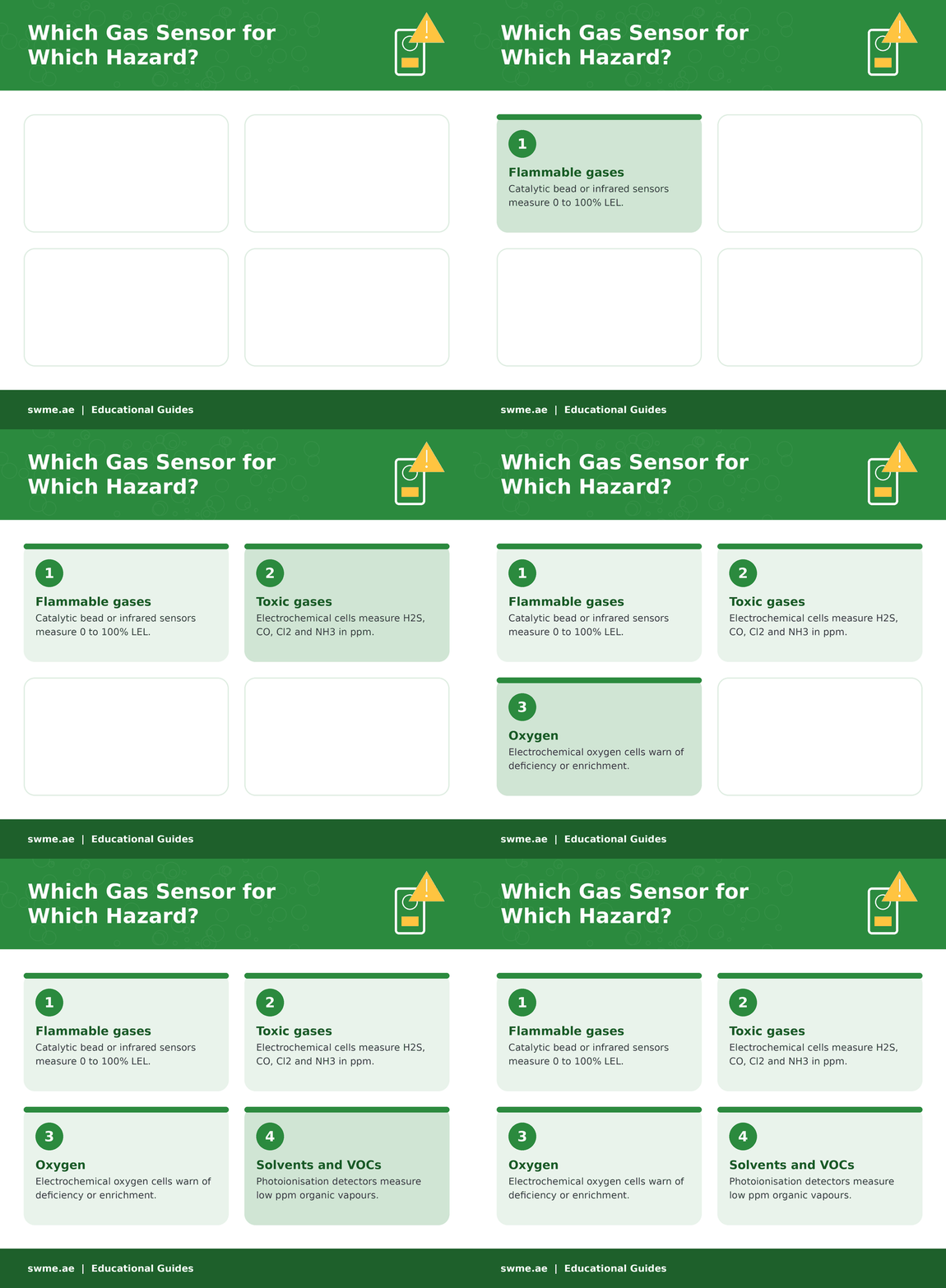
Main Types of Gas Sensors
Catalytic bead (pellistor)
Two small heated beads form part of a bridge circuit. One bead is coated with a catalyst. Flammable gas burns on this bead, raises its temperature and changes its resistance. The sensor is simple and responds to most flammable gases. However, it needs oxygen to work, and silicones or lead compounds can poison the catalyst.
Infrared (NDIR)
Hydrocarbon molecules absorb infrared light at specific wavelengths. An infrared sensor shines light through the gas and measures how much is absorbed. It cannot be poisoned, works without oxygen and is fail safe, because a fault in the light path is detected. It cannot detect hydrogen, which does not absorb infrared light.
Electrochemical
A small cell with electrodes and electrolyte produces a current when the target gas reacts. Each cell is designed for one gas, such as H2S, CO or oxygen. These gas sensors are sensitive at low ppm levels and use little power, but they have a limited life, typically 2 to 3 years, and can be affected by extreme heat and dryness.
Photoionisation (PID)
Ultraviolet light ionises organic vapours, and the resulting current is measured. PID detectors measure volatile organic compounds, such as benzene and solvents, down to parts per billion.
Semiconductor (metal oxide)
The resistance of a heated metal oxide changes in the presence of gas. These sensors are robust and low cost, but less selective, so they suit simple alarm duties rather than precise measurement. For background on sensor electronics, see the electronic sensors articles on instrumentationblog.in.
Did you know?
The lower explosive limit of methane is about 5% volume in air. A gas detector that reads 20% LEL is therefore seeing only about 1% methane by volume. Alarms are usually set at 10 to 20% LEL to give a large safety margin before any explosive mixture forms.
Comparison of Gas Sensors
| Sensor type | Detects | Strengths | Limits |
|---|---|---|---|
| Catalytic bead | Flammable gases, including hydrogen | Low cost, broad response | Needs oxygen, can be poisoned |
| Infrared | Hydrocarbons, CO2 | No poisoning, fail safe, long life | Cannot see hydrogen |
| Electrochemical | Toxic gases, oxygen | Very sensitive, low power | 2 to 3 year life, temperature limits |
| PID | VOCs and solvents | ppb sensitivity | Lamp cleaning, not gas specific |
| Semiconductor | Various gases | Robust, low cost | Poor selectivity, humidity effects |
How to Choose Gas Sensors
- Identify the gases. List every flammable and toxic gas that could be released, with its LEL or exposure limit.
- Match technology. Infrared for hydrocarbons, catalytic for hydrogen, electrochemical for toxics and oxygen.
- Check the environment. Consider temperature, humidity, dust, poisons and hazardous area classification.
- Plan the system. Decide on fixed or portable, wired or wireless, and alarm levels.
- Plan maintenance. Confirm calibration intervals, sensor life and spare part availability.
Wireless detectors can reduce cabling costs on large sites. Read about the Vanguard WirelessHART gas detector for an example. Placement is just as important as sensor type; see our gas detector placement guide. To check signal scaling in the control system, use the 4 to 20 mA scaling calculator. For safety loop calculations, the PFDavg calculator is a helpful starting point.
Calibration and Bump Testing
Bump test
- A short exposure to test gas to prove the alarm works.
- Recommended before each day of use for portable detectors.
- Does not adjust the reading.
Calibration
- Adjusts zero and span using certified test gas.
- Typical interval 3 to 6 months for fixed detectors.
- Record results for audits and safety reviews.
Calibration methods for analytical instruments are covered in the analytical measurement articles on instrumentationblog.in.
Common Mistakes to Avoid
Frequently Asked Questions
Which gas sensor is best for methane?
Infrared sensors are usually preferred for methane, because they cannot be poisoned and work without oxygen.
How long do electrochemical sensors last?
Typically 2 to 3 years, depending on the gas, temperature and exposure history.
What does LEL mean?
LEL is the lower explosive limit, the lowest concentration of a gas in air that can ignite.
