Key takeaways
- A correct range keeps the pointer in the middle of the dial, where the gauge is most accurate and lasts longest.
- Accuracy class, dial size and wetted materials should match the job, not the cheapest catalogue option.
- Pulsation, vibration and hot media need accessories such as liquid filling, snubbers and siphons.
- Most gauge failures come from poor selection, not poor manufacturing.
The Bourdon tube pressure gauge is the most common instrument in any plant. Because it is so familiar, it is often ordered without much thought. However, when you select a pressure gauge carefully, it gives years of reliable service. When you do not, it fails early, reads wrongly or even becomes a safety risk.
This guide walks through the decisions in the order an engineer should make them. SWME supplies pressure gauges, digital pressure gauges and accessories for Oil and Gas, Water and Utilities projects across the GCC.
In this guide
How a Bourdon Tube Gauge Works
Inside the case is a curved, flattened metal tube closed at one end. When pressure enters the tube, it tries to straighten. A linkage and gear movement convert this small movement into the rotation of the pointer across the dial.
For low pressures, diaphragm or capsule elements replace the Bourdon tube, because they respond to smaller forces. In addition, diaphragm elements tolerate viscous or slightly dirty media better than a narrow tube.
Selecting the Range
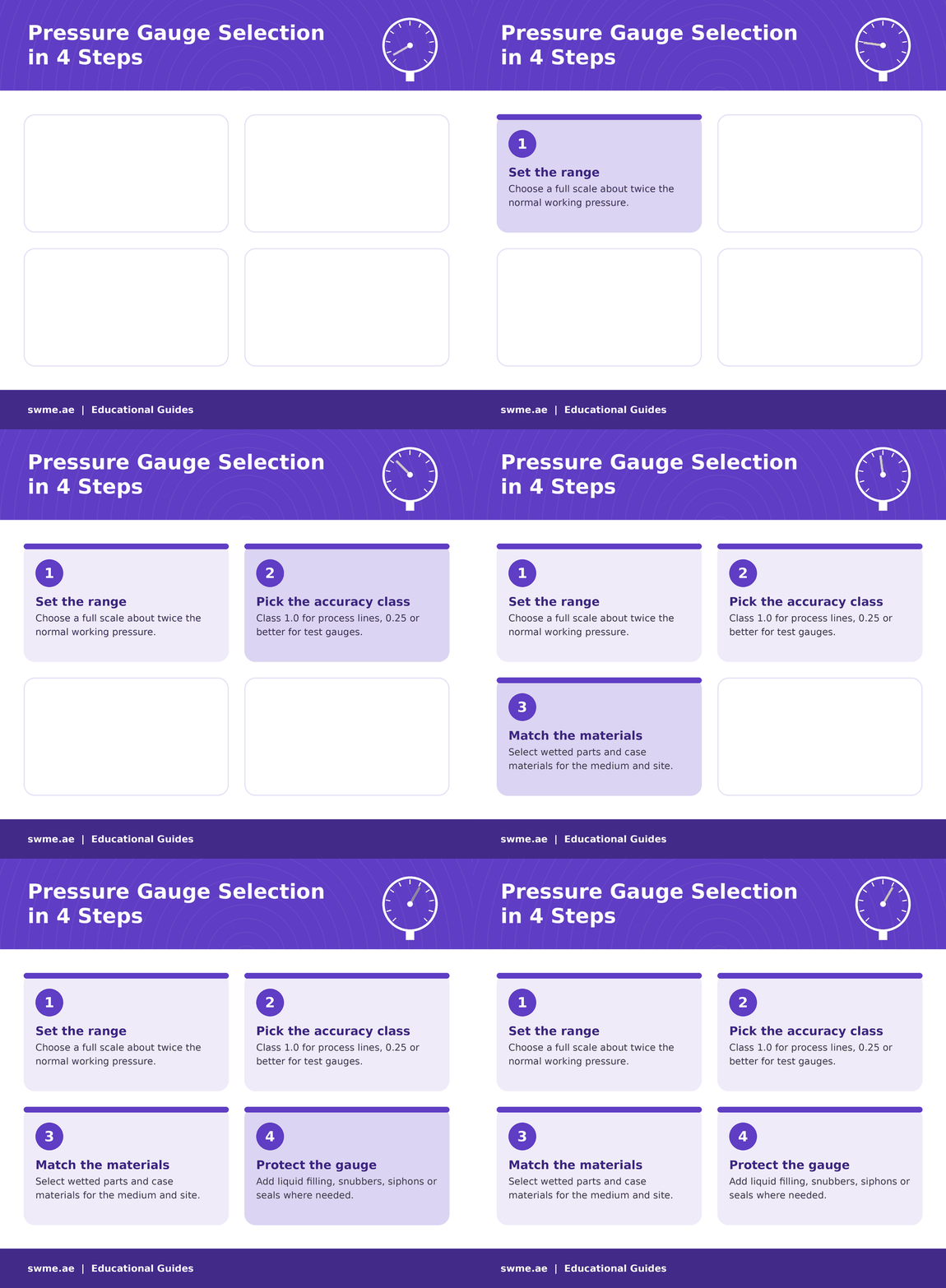
The range is the most important choice. As a rule, the normal working pressure should sit in the middle third of the scale, and the full scale value should be about twice the normal pressure.
Rules of thumb
Did you know?
A Bourdon tube that runs continuously close to its full scale value slowly takes a permanent set. The pointer then no longer returns to zero, and the gauge reads low across the whole range. Correct range selection is the cheapest way to extend gauge life.
Accuracy Class and Dial Size
Accuracy class is the maximum error as a percentage of full scale. For example, a class 1.0 gauge with a 0 to 10 bar range may be off by up to 0.1 bar anywhere on the scale. You can estimate total errors with the instrument accuracy calculator.
| Accuracy class | Typical dial size | Typical use |
|---|---|---|
| 0.1 to 0.25 | 160 mm and above | Test and reference gauges |
| 0.6 | 100 to 160 mm | Critical process points |
| 1.0 | 100 to 160 mm | General process lines |
| 1.6 to 2.5 | 50 to 63 mm | Utilities, compressors, panels |
Larger dials are easier to read from a distance and usually offer better accuracy. A 100 mm dial is the common choice for process lines, while 63 mm dials suit panels and machinery.
Wetted Parts and Case
Wetted parts
- Brass or bronze for air, water and non corrosive media.
- 316 stainless steel for most process and offshore duties.
- Monel or Hastelloy for seawater, acids and chlorides.
- Diaphragm seals for corrosive, viscous or crystallizing media.
Case and window
- Stainless steel case for outdoor and coastal sites.
- Safety pattern case with solid front and blowout back for high pressure.
- Laminated safety glass or polycarbonate window.
- IP65 or higher ingress protection for washdown areas.
Where the medium could damage the gauge, a diaphragm seal isolates the Bourdon tube from the process. The seal also allows the gauge to be mounted remotely on a capillary.
Protecting the Gauge
SWME supplies gauge accessories and manifolds and fittings for all of these needs. For a deeper look at fluid behaviour in pipes, see the water hammer calculator, which estimates pressure surges after sudden valve closure.
Checklist to Select a Pressure Gauge
- Medium. Define the fluid, its temperature and whether it is corrosive, viscous or contains solids.
- Pressure. State normal, maximum and minimum pressure, including vacuum and spikes.
- Range. Normal pressure in the middle third, full scale about twice normal.
- Accuracy and dial. Choose class and dial size to suit the reading distance and importance.
- Materials. Select wetted parts and case for the medium and environment.
- Connection. Specify thread type and size, such as 1/2 inch NPT, and bottom or back entry.
- Accessories. Add filling, snubber, siphon, seal or valve as the duty requires.
- Standards. Confirm compliance with EN 837 or ASME B40.100 where specified.
Following this list each time you select a pressure gauge also makes spare part management easier, because the plant ends up with fewer, well defined gauge types. When a remote reading is needed, consider a pressure transmitter instead. More background is available in the pressure measurement articles on instrumentationblog.in.
Common Mistakes to Avoid
Frequently Asked Questions
When should I choose a liquid filled gauge?
Choose one whenever there is vibration or pressure pulsation, such as near pumps and compressors. The fill damps the pointer and protects the movement.
How often should pressure gauges be calibrated?
Most plants check process gauges every 12 months. Gauges on safety related duties often need shorter intervals.
What is the difference between EN 837 and ASME B40.100?
Both are pressure gauge standards. EN 837 is common in Europe and the Middle East, while ASME B40.100 is common in North American specifications.
