Key takeaways
- No single flow meter suits every application; the fluid decides the technology.
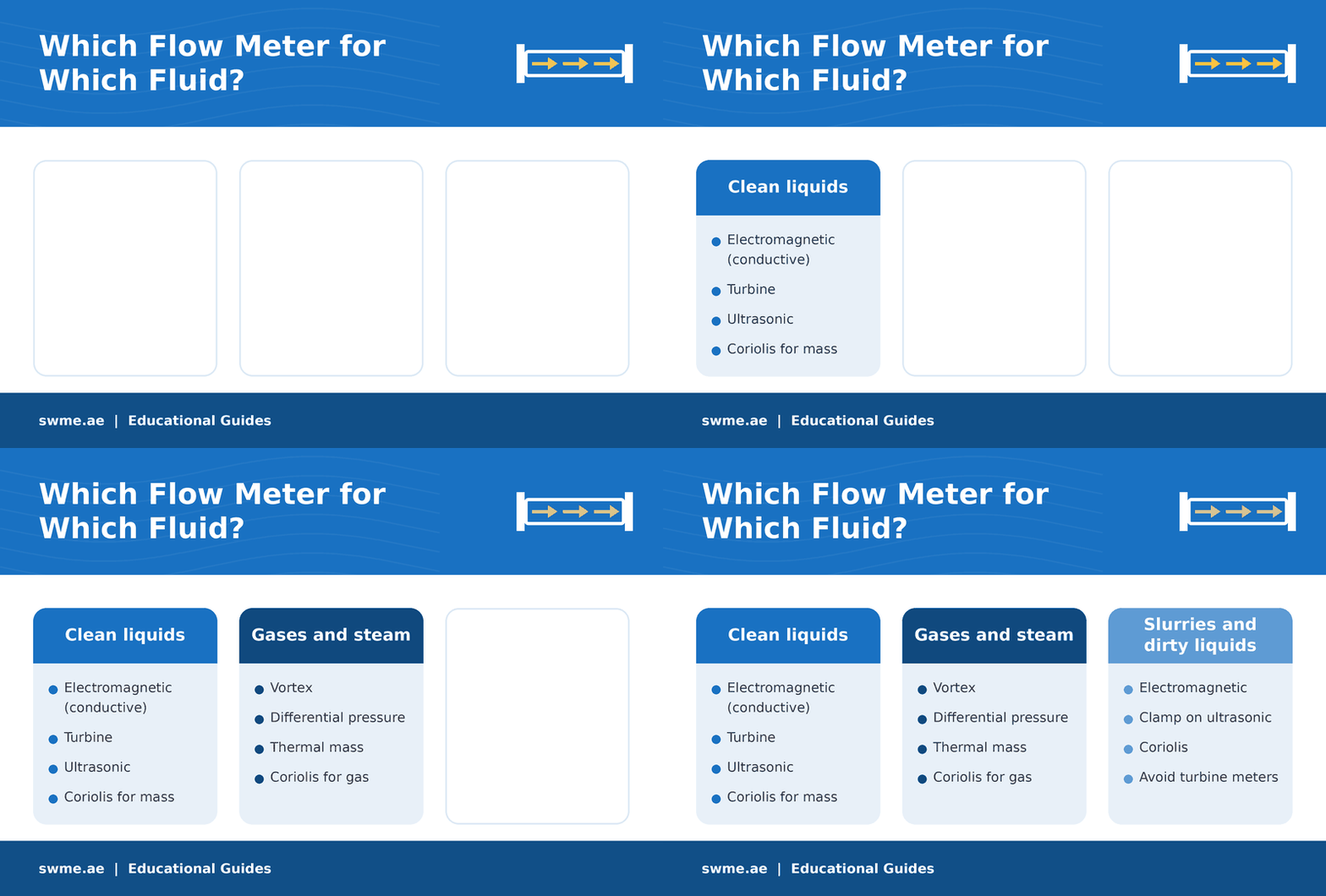
- Electromagnetic meters suit conductive liquids, vortex meters suit steam and gases, Coriolis meters give direct mass flow.
- Straight pipe runs, turndown and pressure loss matter as much as accuracy.
- Clamp on ultrasonic meters measure without cutting the pipe.
Flow is one of the most measured variables in any process plant. It is also one of the most varied, because the right meter depends on the fluid, the pipe and the purpose of the measurement. Understanding the main types of flow meters helps you avoid costly mistakes at the design stage.
This guide explains each technology in plain terms and compares their strengths. SWME supplies flowmeters, flow transmitters and flow switches from leading principals.
In this guide
Flow Measurement Basics
Flow can be expressed as volume per unit time, such as cubic metres per hour, or as mass per unit time, such as kilograms per hour. For liquids at constant temperature the two are closely related. For gases and steam, density changes with pressure and temperature, so mass flow or corrected volume flow is usually required.
In addition, the way the fluid moves in the pipe matters. The Reynolds number calculator tells you whether flow is laminar or turbulent, which affects many meter types. You can also check line velocity with the pipe flow velocity calculator.
Main Types of Flow Meters
Differential pressure
A restriction such as an orifice plate, venturi or nozzle creates a pressure drop that rises with the square of flow. A differential pressure transmitter measures this drop. It is a proven, low cost method for clean liquids, gases and steam. You can explore the relationship with the orifice plate flow calculator.
Electromagnetic
A magnetic field across the pipe induces a voltage in a conductive liquid. The voltage is proportional to velocity. There are no moving parts and no pressure loss, which makes these meters ideal for water, wastewater and slurries. Read how an electromagnetic flow meter works for more detail.
Vortex
A bluff body in the flow sheds vortices at a frequency proportional to velocity. Vortex meters suit steam, gases and clean liquids, and they handle high temperatures well.
Turbine
A rotor spins at a speed proportional to flow. Turbine meters offer good accuracy for clean, low viscosity fluids, such as fuel and light oils, but their bearings wear over time.
Ultrasonic
Transit time meters compare the travel time of sound pulses with and against the flow. Clamp on versions mount outside the pipe, so you can measure without shutting down. See the XFT clamp on ultrasonic flow meter for an example.
Coriolis
Vibrating tubes twist slightly as mass flows through them. The twist is proportional to mass flow, and the vibration frequency gives density. Coriolis meters are very accurate but cost more, especially in large sizes.
Variable area
In a rotameter a float rises in a tapered tube until it balances the flow. It needs no power and gives a local reading, which makes it popular for purge, dosing and utility lines.
Did you know?
A differential pressure flow meter has a natural turndown of only about 4 to 1, because the signal falls with the square of flow. At 10% flow, the differential pressure is just 1% of its maximum. This is why low flow cutoffs are used. Try the low flow cutoff calculator to see the effect.
Comparing the Types of Flow Meters
| Meter type | Best for | Pressure loss | Typical accuracy | Moving parts |
|---|---|---|---|---|
| Differential pressure | Clean liquids, gas, steam | Medium to high | 1 to 2% | No |
| Electromagnetic | Conductive liquids, slurries | None | 0.2 to 0.5% | No |
| Vortex | Steam, gas, clean liquids | Low | 0.75 to 1.5% | No |
| Turbine | Clean, low viscosity liquids | Medium | 0.25 to 0.5% | Yes |
| Ultrasonic | Large pipes, clean liquids | None | 0.5 to 2% | No |
| Coriolis | Mass flow, density, custody transfer | Medium | 0.1 to 0.2% | No |
| Variable area | Local indication, purge, utilities | Low | 1.6 to 4% | Float only |
How to Select a Flow Meter
- Fluid. Identify liquid, gas, steam or slurry, plus conductivity, viscosity and cleanliness.
- Measurement. Decide between volume flow, mass flow or a simple flow or no flow signal.
- Range. State minimum, normal and maximum flow, and the turndown required.
- Line. Note pipe size, material, pressure and temperature.
- Installation. Check available straight runs before and after the meter.
- Output. Confirm 4 to 20 mA, pulse, HART or fieldbus requirements.
Comparing the types of flow meters against this checklist usually narrows the choice to one or two options. For basic formulas, the flow rate formula guide is a useful reference.
Installation Tips
Do
- Provide the straight runs stated by the manufacturer.
- Keep liquid meters full; install in a rising line where possible.
- Ground electromagnetic meters correctly.
Avoid
- Installing right after pumps, valves or elbows.
- Air or gas pockets in liquid lines.
- Vibration sources close to vortex and Coriolis meters.
Common Mistakes to Avoid
If a meter already shows strange values, read our guide on flow meter incorrect readings, causes and fixes.
Frequently Asked Questions
Which flow meter is the most accurate?
Coriolis meters are generally the most accurate, often within 0.1% of reading, and they measure mass flow directly.
Which flow meter has no moving parts?
Electromagnetic, ultrasonic, vortex, Coriolis and differential pressure meters all have no moving parts in the flow.
Can one meter measure both liquid and gas?
Coriolis and some ultrasonic meters can, but most installations use a technology optimised for one phase.
