Key takeaways
- A bump test is a quick qualitative check that sensors respond and alarms work; it makes no adjustment.
- A full calibration adjusts the reading to match a known, traceable gas concentration.
- Guidance calls for a bump test or calibration check before each day's use of portable detectors.
- A detector that fails a bump test must be fully calibrated, or removed from service.
A gas detector that looks fine can still be blind. Sensors age, drift and can be poisoned, and nothing on the display shows it. A bump test and a calibration are the two routine checks that catch this, but they answer different questions.
This guide explains each check, how often to do them and what to do when a detector fails. SWME supplies fixed and portable gas detectors and test and calibration equipment across the GCC.
In this guide
Bump Test vs Calibration: The Terms
Instrumentation Tools summarises the definitions used in OSHA guidance on verifying direct reading portable gas monitors:
Side by Side
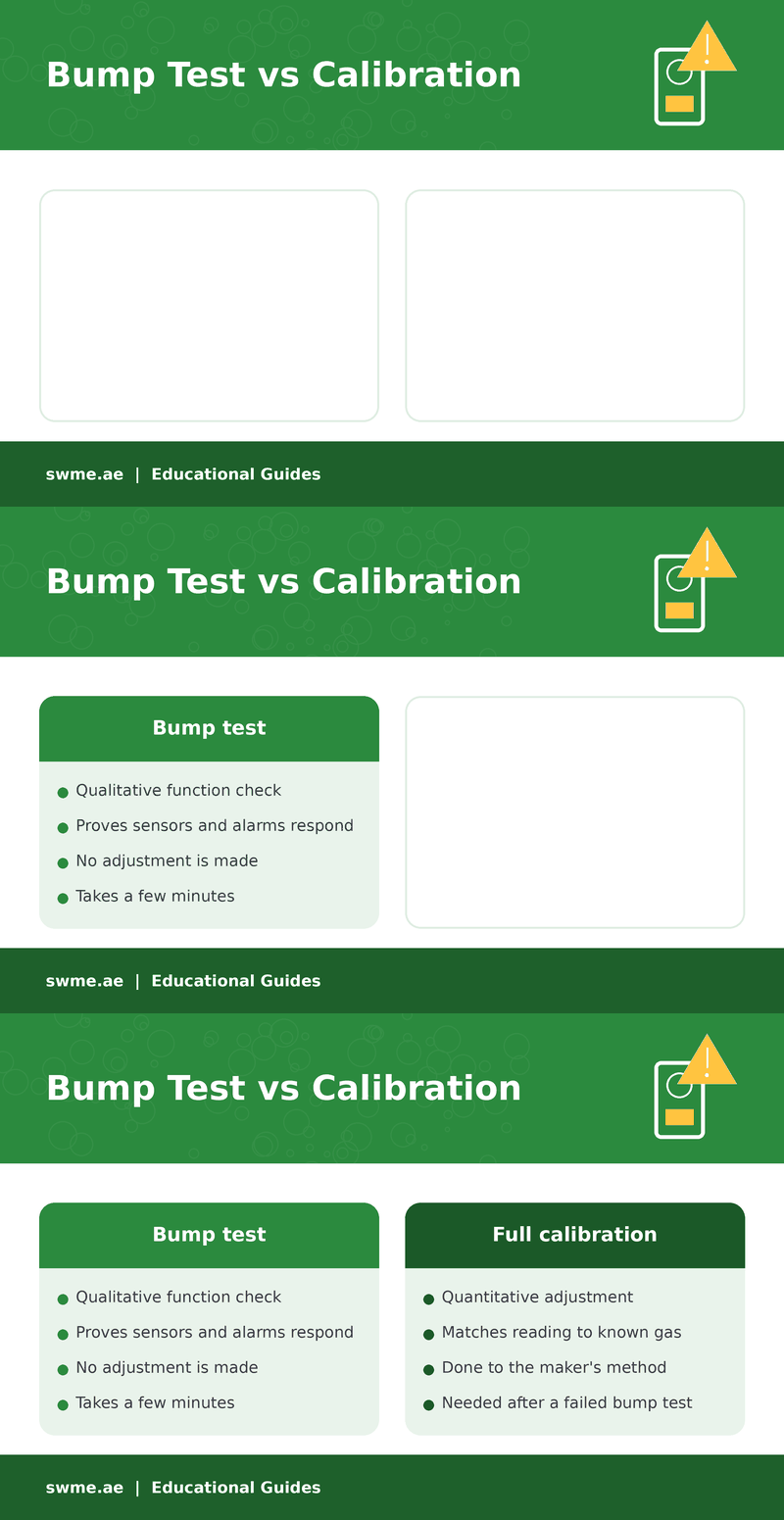
| Point | Bump test | Full calibration |
|---|---|---|
| Purpose | Proves response and alarms | Corrects reading accuracy |
| Result | Pass or fail | Sensor adjusted to known gas |
| Adjustment | None | Yes |
| Time | A few minutes | Considerably longer |
| When | Before each day's use | Maker's schedule, and after a failed test |
The timing points come from ISHN, which notes that a bump test can take as little as a few minutes while a full calibration through the instrument menu takes considerably longer.
How Often to Test
ISHN quotes the ISEA position: a bump test or full calibration of direct reading portable gas monitors should be made before each day's use. Instrumentation Tools adds that less frequent checks may be allowed only after at least 10 days of daily checks in the intended atmosphere with no adjustments needed, and the interval should not exceed 30 days.
Did you know?
Sensors do not last forever. ISHN gives a typical sensor life of two to three years, and notes that drift does not happen at predictable intervals, which is why the check is daily rather than yearly. For sensor types, read types of gas sensors.
When a Detector Fails
An instrument that fails a bump test or calibration check must be fully calibrated before further use, or taken out of service. As an example of a pass limit, Instrumentation Tools describes a tolerance of plus or minus 10%: with 20 ppm H2S test gas, the reading must settle between 18 and 22 ppm. Manufacturers set their own limits, so always use the value in the manual. The calibration error calculator helps you work out the error as a percentage.
Good Practice Checklist
- Use certified gas. Use calibration gas certified to a traceable standard and never past its expiry date.
- Zero in clean air. Zero only where the air is known to be clean.
- Clear the peaks. Bump tests and calibrations record new peak readings, so clear peaks afterwards.
- Keep records. Log every bump test and calibration with date, gas and result.
- Know your alarms. Set alarm levels with LEL and UEL in mind for flammable gas.
Common Mistakes to Avoid
For response checks, the sensor response time calculator is useful, and Instrumentation Blog has more calibration reading. For wireless fixed detectors, see our Vanguard WirelessHART gas detector post.
Frequently Asked Questions
What is a bump test?
A short exposure to test gas that proves the sensors respond and the alarms activate. It does not adjust the reading.
How often should a gas detector be bump tested?
Industry guidance calls for a bump test or calibration before each day's use of portable detectors.
What happens if a bump test fails?
The detector must be fully calibrated before further use, or removed from service.
