Key takeaways
- A strapping table, also called a tank capacity table, lists the volume of liquid at each measured height.
- In a vertical cylinder volume rises in a straight line with level. In horizontal and spherical tanks the cross section changes with height, so the relationship curves.
- Between rows, transmitters and DCS characterisers interpolate in straight lines, so closer rows give smaller errors.
- The table volume is the total observed volume. Free water, temperature and sediment corrections turn it into a standard or net volume.
A strapping table converts the level a gauge or level transmitter measures into the volume of liquid in the tank. APG explains in its note on tank strapping charts that the name comes from measuring the tank with a steel tape, or strap, and that the table is most useful for tanks whose shape is not linear. SWME supplies the transmitters and level gauges that feed these tables in tank farms across the UAE.
In this guide
Why Level and Volume Differ
The control.com textbook chapter on material volume defines a strapping table as a data table correlating known volumes with measured heights. For a vertical cylinder the cross section is constant, so volume is proportional to height. For a horizontal cylinder the volume is complicated because the cross sectional area changes with height, and the same applies to a sphere.
Volume Formulas
Level to volume for common shapes
These formulas assume a perfect shape. Real tanks also have tilt and deadwood, which the calibration standards below correct for.
Worked Example and Interpolation
Take a horizontal tank 2.0 m in diameter and 6.0 m long, with flat ends. Full, it holds π × 1.0² × 6.0 = 18.850 m³. The segment formula gives the rows below; the horizontal tank volume calculator returns the same figures and can also solve for level from volume.
| Level, m | Volume, m³ | % of full |
|---|---|---|
| 0.25 | 1.360 | 7.2 |
| 0.50 | 3.685 | 19.6 |
| 0.75 | 6.456 | 34.3 |
| 1.00 | 9.425 | 50.0 |
| 1.50 | 15.164 | 80.4 |
| 2.00 | 18.850 | 100.0 |
The first 0.5 m of level holds 3.69 m³, while the next 0.5 m adds 5.74 m³. Now suppose the table had rows only every 0.5 m. Linear interpolation at 0.75 m would give (3.685 + 9.425) ÷ 2 = 6.555 m³, against the exact 6.456 m³: about 1.5% high. Closer rows near the bottom and top of a horizontal tank, where the curve bends most, keep that error down.
Did you know?
Emerson's engineer's guide to tank gauging says older calibration methods often state an uncertainty of 0.10% in the tank capacity table, while electro optical distance ranging has shown figures as low as 0.01% to 0.02%.
How Tanks Are Strapped
Large upright tanks are calibrated to the API Manual of Petroleum Measurement Standards, Chapter 2.2. AmSpec's summary of tank calibration methods describes the main ones:
Calibration methods
The calculation then applies corrections. ISO 7507 Part 1 requires a liquid head correction, because tanks expand under the head of liquid they hold, and covers shell temperature, tilt up to 3% from vertical, and deadwood, meaning any fitting that adds or takes up volume.
Using a Strapping Table
The table can live in the field device or in the control system.
In the transmitter
- Endress+Hauser Cerabar S, Deltabar S and Deltapilot S accept a linearisation table of 2 to 32 points
- Points entered by hand or semi automatically
- VEGA's VEGAMET 515 offers linear, cylindrical tank, spherical tank and user curves
In the DCS or tank gauging system
- A characteriser block interpolates linearly between the nearest pair of points
- Typically ten to one hundred points
The Endress+Hauser Cerabar S manual describes the 32 point table. A differential pressure level transmitter measures head, so density matters too; the hydrostatic pressure formula links head to level. Our comparison of radar and ultrasonic level measurement covers the other common inputs to a strapping table.
From Observed to Standard Volume
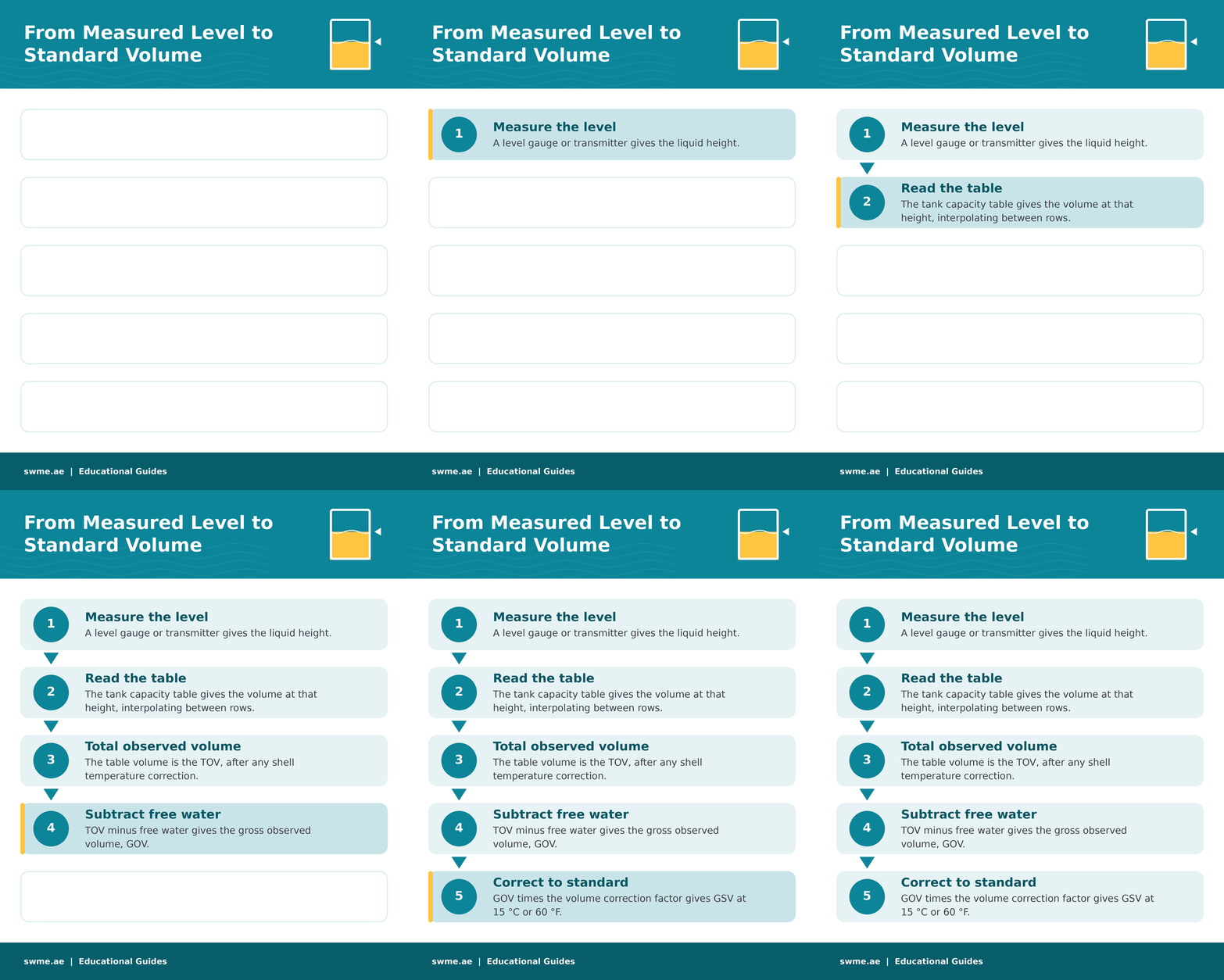
Emerson's engineer's guide to tank gauging sets out the chain. The tank capacity table turns level into total observed volume, TOV. Subtracting free water gives gross observed volume, GOV. GOV multiplied by the volume correction factor gives gross standard volume, GSV, at 15 °C or 60 °F, and subtracting sediment and water gives net standard volume, NSV. Floating roof tanks also need a correction for the volume the roof displaces.
The table itself also changes with shell temperature. For a carbon steel shell Emerson applies a factor of (1 + ΔT × 0.000022), so a 20 °C difference between calibration and shell temperature changes the table volume by 0.044%.
Recalibration
ISO 7507 Part 1 says tanks should be recalibrated as national regulations require, or whenever the calibration becomes suspect. AmSpec, quoting API, suggests total recalibration every 15 years for custody transfer tanks, 15 to 20 years for others, and a check of the bottom course, including tilt, every five years for custody transfer service. Related level measurement articles cover the instruments themselves.
Common Mistakes to Avoid
Frequently Asked Questions
Is a strapping table the same as a tank capacity table?
Yes. Both terms describe the table of volume against measured height for one particular tank.
Why can't I use a formula instead?
You can for an ideal shape. Real tanks have tilt and deadwood, and large tanks are calibrated to API or ISO methods that correct for them.
How many points does a transmitter need?
It depends on the device. The Endress+Hauser Cerabar S accepts up to 32 points; DCS characterisers typically use ten to one hundred.
