Key takeaways
- A temperature switch opens or closes an electrical contact when the temperature goes above or below a set level.
- Mechanical types use the expansion of a bimetal, liquid or gas and need no power; electronic types read an RTD.
- The deadband is the gap between the setpoint on rising temperature and the reset point on falling temperature.
- A limiter stays tripped after an over temperature until someone presses reset.
A temperature switch gives a plain on or off signal at a chosen temperature: switch off a heater, start a fan on a compressor, or act as a high limit. SWME supplies temperature switches, thermowells and RTD and thermocouple sensors for plants across the UAE and GCC.
In this guide
How a Temperature Switch Works
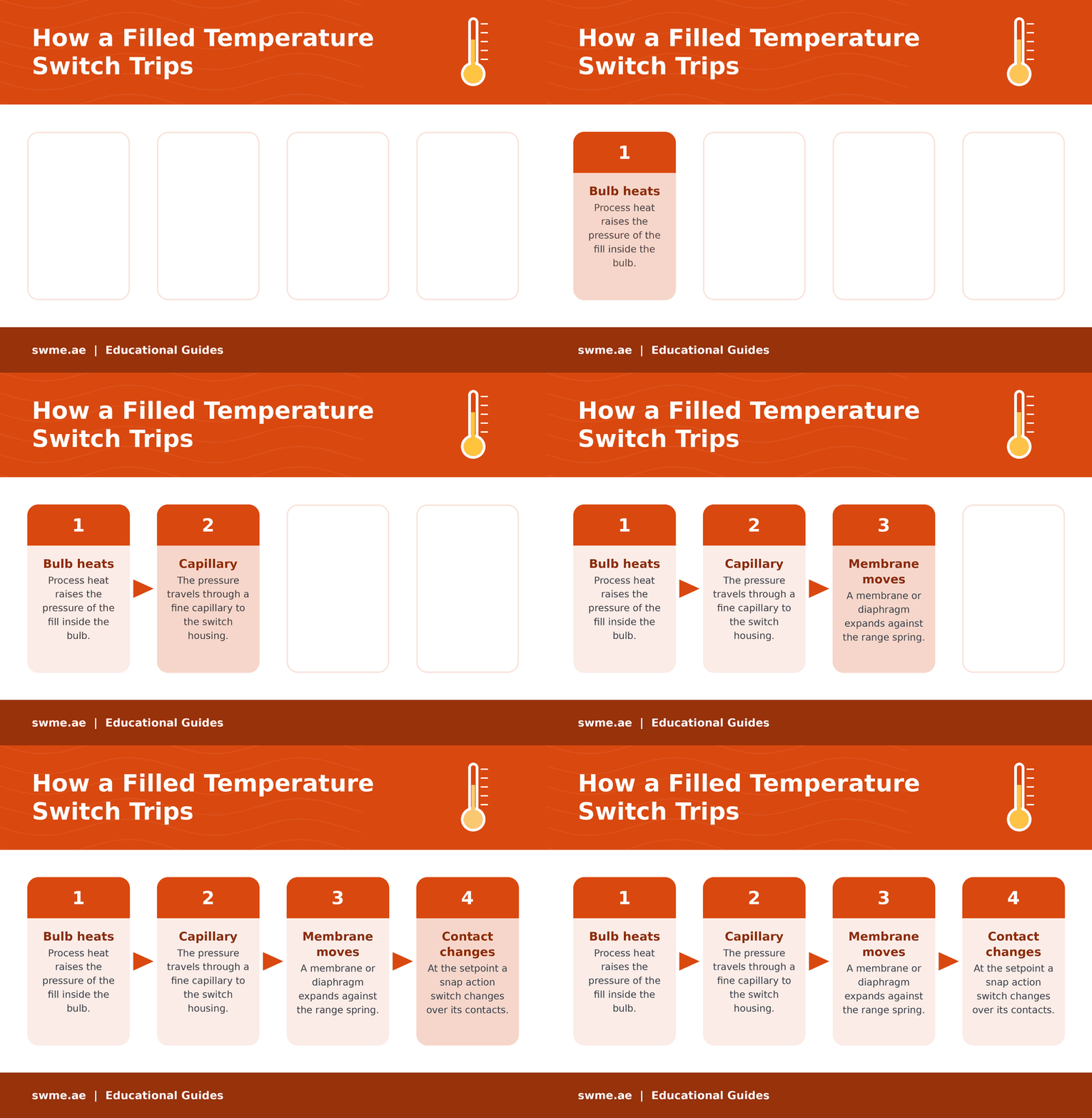
JUMO explains that mechanical switches rely on metals, liquids or gases expanding as they warm until they actuate a contact. In a filled system the probe, capillary and membrane form a sealed unit. When the probe heats up the system pressure rises, the membrane expands and a snap action switch trips.
Baumer, quoted by Instrumentation Tools, describes the same idea as a pressure switch with a sealed bulb fitted to its pressure port. The fill's vapour pressure acts on a diaphragm and piston assembly, which works a micro switch at the setpoint. Compare it with our guide to what a pressure switch is.
Temperature Switch Types
| Type | How it senses | Points from JUMO |
|---|---|---|
| Bimetal | Two metals with different expansion rates, for example copper and nickel, are rolled together and bend with temperature | Switching point fixed in production; vibration resistance up to 10 g is not uncommon; screws in like a sensor |
| Filled (gas or liquid) | Fill pressure in a probe and capillary moves a membrane | Capillary bore 0.2 mm, practical length up to 5 m; switching point usually set on the housing |
| Electronic | An RTD signal is evaluated electronically | Setpoint by keypad, optional display, can also give a 4 to 20 mA output |
Mechanical switches are passive and need no supply voltage. JUMO says most handle switching currents of 10 A or more, so small heaters can be switched directly, while larger loads need a contactor. The bimetal principle is the same one used in our bimetal thermometer guide.
Setpoint and Deadband
The setpoint is where the contact changes. The reset point is where it changes back, and the gap between the two is the deadband, which JUMO calls switching hysteresis. Baumer says the setpoint must sit inside the adjustable range and be stated as rising or falling, that the deadband is normally fixed, and that the standard factory setting is 50% of the scale on falling temperature, though this varies by vendor.
Did you know?
Some switches, such as WIKA's TS 972, let you adjust the differential. Its manual lists a switch differential larger than the switch point as one reason a contact will not switch.
Contacts and Limiters
JUMO also describes pairing a controller with a separate switch, so the controller regulates and the switch acts as an independent limit. For a continuous signal instead, see temperature transmitters.
Installation
- Orientation. WIKA's TS 972 manual says to mount vertically with the bulb fully immersed.
- Temperature limit. The same manual warns the sensing element is permanently damaged if its maximum temperature is exceeded even once.
- Thermowell. Use one for incompatible media; WIKA also recommends it above 1 bar line pressure or above boiling point. See what is a thermowell.
- Capillary care. Do not carry the switch by the capillary or bend it sharply at the bulb.
- Environment. Avoid temperature shocks, and stop ice forming in humid conditions below zero.
For sensor lag, try the sensor response time calculator, and for electronic switches the Pt100 resistance calculator. More reading is in the Instrumentation Blog temperature section and our blog on the UE 400 series pressure and temperature switch.
Common Mistakes to Avoid
Frequently Asked Questions
Does a temperature switch need power?
Mechanical types do not. Electronic types do, because they evaluate an RTD signal.
What is the deadband?
The difference between the setpoint on rising temperature and the reset point on falling temperature.
What is the difference between a switch and a limiter?
A limiter stays tripped after an over temperature until it is reset by hand.
