Key takeaways
- A pressure switch opens or closes an electrical contact when process pressure reaches a set value.
- Electromechanical switches use a diaphragm, piston, bellows or bourdon tube against a spring and need no external power.
- Deadband is the gap between the trip point and the reset point; it stops the contacts from chattering.
- Select by range, setpoint position, overpressure, wetted materials, contact rating and approvals.
Many control and protection functions only need to know when pressure crosses one value. A pressure switch does exactly that: it senses pressure and mechanically opens or closes an electrical circuit at a set point. Pressure switches are used with pumps, boilers, burners, compressors and filters wherever a pressure change must trigger an electrical response.
SWME supplies pressure switches and differential pressure switches for oil and gas, water and utility projects across the GCC.
In this guide
How a Pressure Switch Works
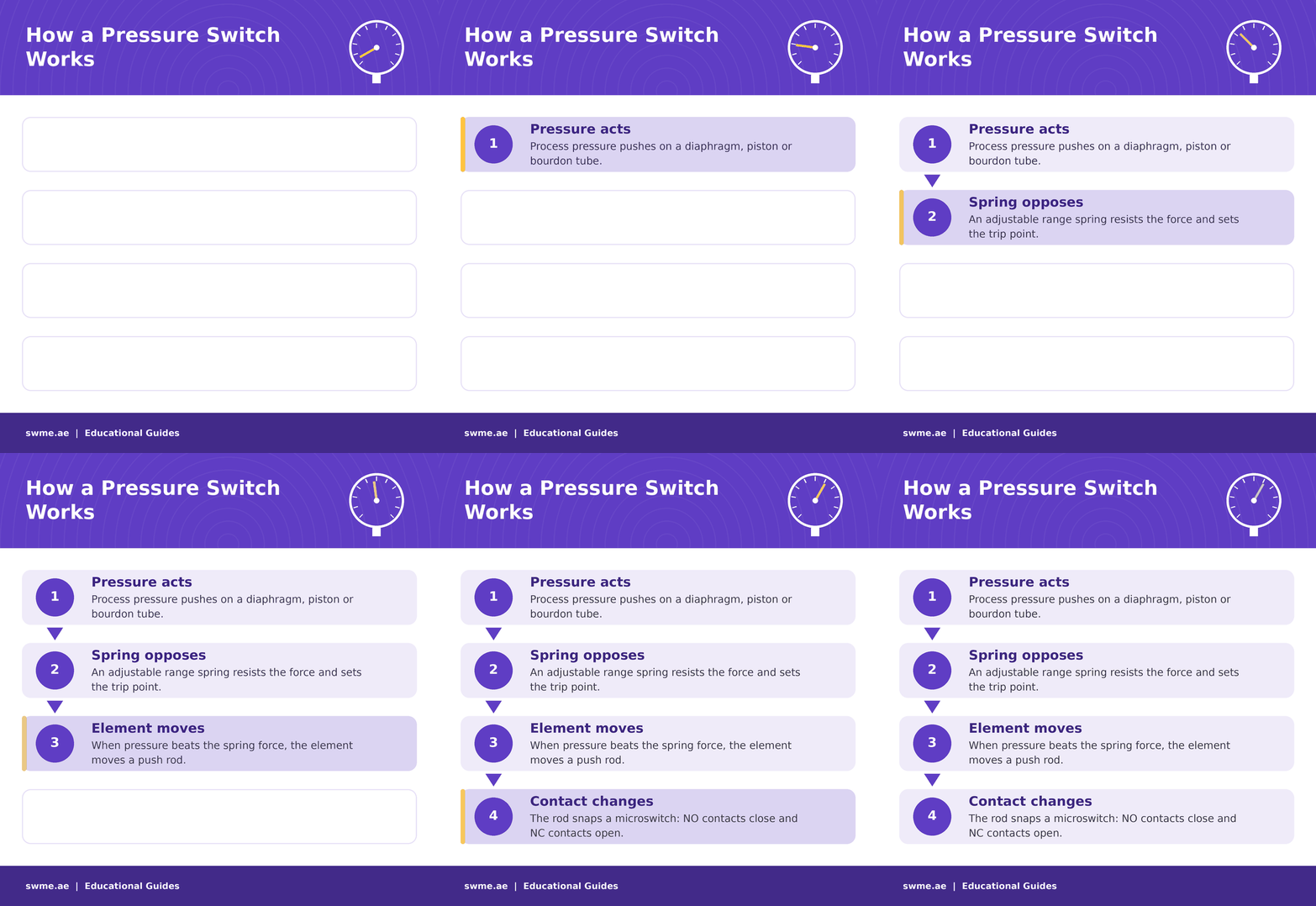
In an electromechanical design, process pressure acts on a sensing element against an opposing range spring. An adjusting nut sets the spring force, which sets the trip point. Only when the pressure force exceeds the spring force does the element move, pushing a rod that changes the state of a snap acting microswitch. According to Ashcroft, raising the adjusting nut reduces the spring force and lowers the setpoint, while lowering it raises the setpoint.
Sensing elements
Contacts and Setpoint
A normally open (NO) contact is open below the setpoint and closes above it. A normally closed (NC) contact is closed below the setpoint and opens above it. For vacuum switches the behaviour is reversed. An SPDT microswitch has one NO, one NC and one common terminal, while a DPDT version uses two SPDT switches that actuate together, so two separate loads switch at the same time.
Where the setpoint sits in the range matters. AutomationDirect advises placing it in the middle of the range for electromechanical switches, to balance accuracy and switch life, and in the upper 25% of the range for solid state switches.
Deadband Explained
Deadband, also called differential or hysteresis, is the difference between the pressure at which the switch trips and the pressure at which it resets. On a rising setpoint the switch resets at a lower pressure; on a falling setpoint it resets at a higher pressure. As Omega explains, deadband prevents rapid switching that would disturb the process and wear the contacts.
As a rule, use a narrow deadband for alarms and a wider one for control duties, such as starting and stopping a pump. Bourdon tube and diaphragm switches typically have narrow deadbands, while piston switches have broad ones.
Did you know?
An electromechanical pressure switch needs no external power. Its sensing element moves the contacts directly, so it can switch loads rated at 3 to 15 amps and 120 to 480 VAC. A solid state switch, by contrast, typically needs a 24 VDC supply.
Mechanical vs Solid State Pressure Switch
| Feature | Electromechanical | Solid state |
|---|---|---|
| Sensing | Diaphragm, bellows, bourdon tube or piston | Piezoresistive strain gauge |
| Power | None needed | External supply, usually 24 VDC |
| Deadband | Fixed or rises with setpoint | Adjustable up to 100% of range |
| Cycle life | Diaphragm over 500k, piston over 1 million | Over 50 million |
| Best setpoint position | Middle of range | Upper 25% of range |
Figures from AutomationDirect pressure switch basics. When the process needs a continuous reading rather than one trip point, a transmitter is the better tool; see what is a pressure transmitter and our pressure transmitters.
How to Select a Pressure Switch
- Pressure type. Gauge, absolute or differential; see gauge vs absolute vs differential pressure.
- Range and setpoint. Choose a range that puts the setpoint in the recommended part of the scale.
- Overpressure. Check proof and burst pressure; Ashcroft states burst pressure is typically at least 400% of range. Add a snubber from our gauge accessories where spikes occur.
- Wetted materials. Match diaphragm, piston and O ring materials to the medium and temperature.
- Electrical. Contact type (SPDT or DPDT), rating and hazardous area approvals; read pressure measurement in hazardous areas.
For a product example, see our blog on the UE 400 Series pressure and temperature switch, and our guide to pump protection instruments. In addition, the absolute and gauge pressure calculator and the water hammer calculator help when checking setpoints and surge risk, and Instrumentation Blog has more pressure measurement reading. For wiring switch inputs, see PLC hardware selection.
Common Mistakes to Avoid
Frequently Asked Questions
What is the difference between a pressure switch and a pressure transmitter?
A pressure switch gives an on or off contact at one setpoint, while a transmitter gives a continuous signal across its whole range.
What is deadband on a pressure switch?
It is the difference between the trip pressure and the reset pressure, which prevents the contacts from chattering.
Does a mechanical pressure switch need power?
No. The sensing element operates the contacts directly; only solid state switches need an external supply.
