Key takeaways
- A Coriolis mass flow meter measures mass flow directly, not volume.
- Flow twists vibrating tubes; the time delay between inlet and outlet pickoffs is proportional to mass flow.
- The natural frequency of the tubes gives fluid density, so one meter reports mass flow, density and volume flow.
- Liquid meters must run completely full, and mounting stress upsets the zero.
Custody transfer, batching and dosing often need mass, not volume. A coriolis mass flow meter measures mass flow directly, so changes in temperature, pressure, viscosity or density do not need separate compensation. That makes it a common choice for chemicals, hydrocarbons and food products.
This guide explains the principle, the numbers to know and the installation points that protect accuracy. SWME supplies flowmeters and flow transmitters for process plants across the GCC.
In this guide
Coriolis Mass Flow Meter Working Principle
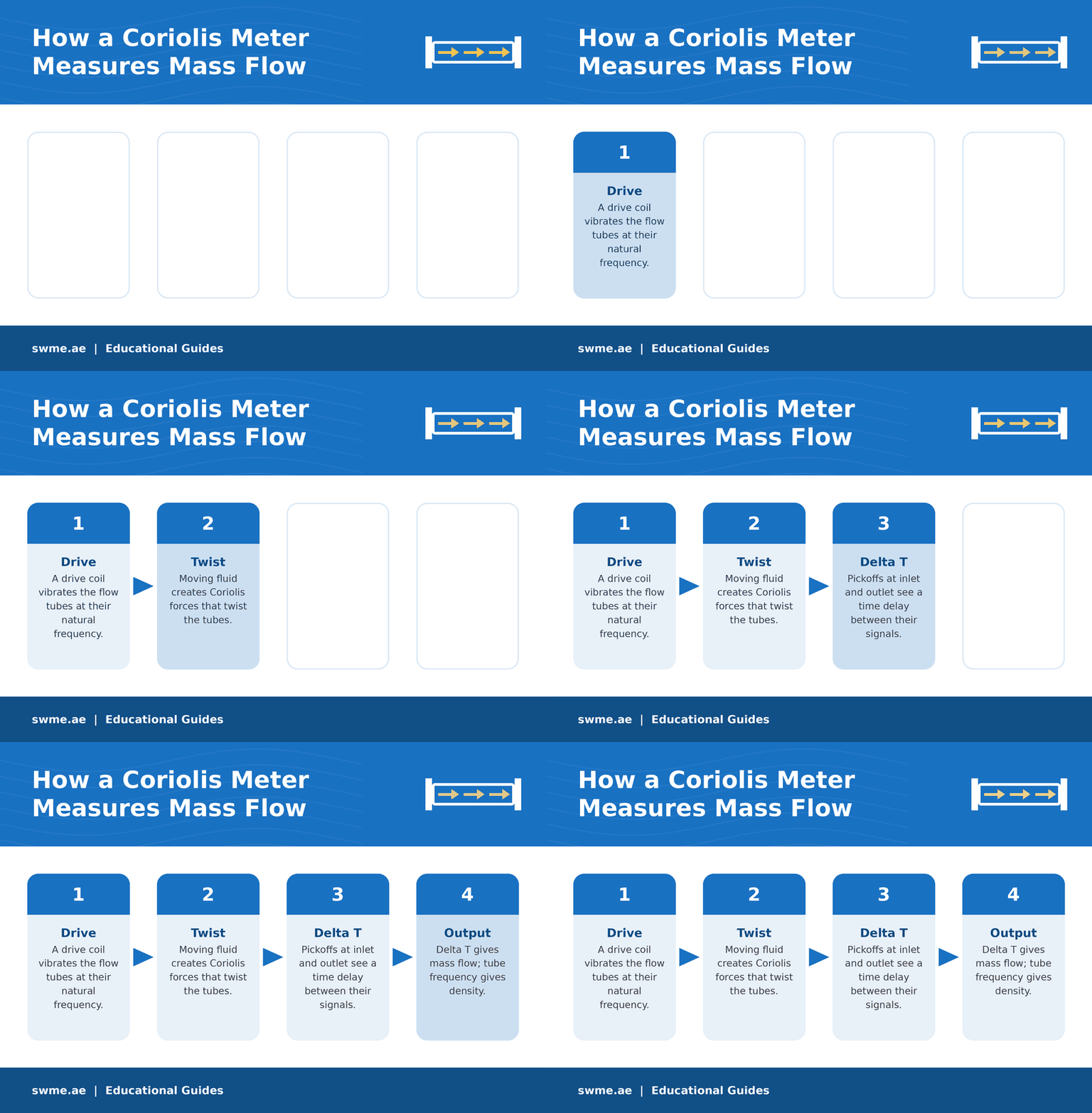
In a common dual tube design described by Emerson, the flow splits so that half enters each of two parallel tubes. A drive coil makes the tubes vibrate against each other at their natural resonant frequency. Magnet and coil assemblies called pickoffs, mounted at the inlet and outlet sides, produce a sine wave that tracks the tube motion.
With no flow, both pickoff signals are in phase. When fluid moves through the vibrating tubes, Coriolis forces twist them in opposition, so the signals shift out of phase. The time difference, called Delta T, is measured in microseconds and is directly proportional to the mass flow rate.
Density and Volume Flow
The same tubes also act as a densitometer. Emerson compares them to a spring with weights: a heavier mass oscillates at a lower frequency. Because tube stiffness stays essentially constant, a change in natural frequency reflects a change in fluid density. Volume flow is then calculated from mass flow and density. To move between the two, use the mass flow rate calculator.
Did you know?
Coriolis meters do not depend on Reynolds number or velocity profile. According to Instrumentation Tools, they need no upstream or downstream straight run or flow conditioning, which is rare among flow technologies.
Accuracy and Turndown
At a glance (Instrumentation Tools)
Use the turndown ratio calculator and the instrument accuracy calculator to test these figures against your own flow range.
Where a Coriolis Mass Flow Meter Fits
Good fit
- Liquids where mass or density matters
- Slurries and non Newtonian fluids
- Some compressed gases and cryogenic liquids
- Pulsating flow and short pipe runs
Poor fit
- Large lines; the largest unit cited has 6 in flanges
- Low pressure gas, described as marginal below 150 psig
- Liquids near boiling, which can cavitate
- Low pressure drop budgets with small bore designs
Instrumentation Tools also notes that the meter is costly, although often comparable to a volumetric meter plus a densitometer. To compare technologies, see types of flow meters and vortex flow meter working principle.
Installation Tips
- Keep it full. A liquid meter must be completely full. Processing Magazine warns that an inverted U tube can trap gas and should not be used for liquids.
- Choose orientation. For a standard U tube meter on liquid, the flag position is usually the most practical; tubes down and horizontal also work with piping changes.
- Avoid stress. Support the piping so the meter body carries no load, because mounting stress upsets the zero.
- Watch pressure drop. Check the drop across the meter and keep liquids above vapour pressure.
- Check the signal. Scale the output with the 4 to 20 mA scaling calculator.
Common Mistakes to Avoid
If readings drift, our blog on flow meter incorrect readings lists common causes, and Instrumentation Blog has more flow measurement reading.
Frequently Asked Questions
What does a Coriolis meter measure?
It measures mass flow directly and also density and volume flow, from one instrument.
Does a Coriolis meter need straight pipe?
No straight run or flow conditioning is normally required, because the measurement does not depend on velocity profile.
Can a Coriolis meter measure gas?
Yes, for some compressed gases, but low pressure gas is difficult and a minimum gas density applies.
