Key takeaways
- A diaphragm seal places a flexible barrier between the process and a pressure instrument.
- Pressure on the diaphragm is passed hydraulically to the instrument through a sealed fill fluid.
- Seals protect gauges, switches and transmitters from corrosive, viscous, abrasive, hot or toxic media.
- Temperature error comes from fill fluid expansion, so fill choice, fill volume and capillary length matter.
Some process media will destroy a bourdon tube or block a small pressure port within weeks. A diaphragm seal, also called a chemical seal, solves this problem by keeping the medium away from the instrument while still passing the pressure through.
This guide explains how a seal works, when you need one and how to keep the reading accurate. SWME supplies diaphragm seals with matching pressure gauges and pressure transmitters for plants across the GCC.
In this guide
How a Diaphragm Seal Works
According to WIKA, a diaphragm seal is a protective device placed between the process media and the pressure instrument. A flexible metal or elastomer diaphragm keeps the medium out of the instrument. The space between the diaphragm and the instrument is completely filled with a fill fluid, which transmits the pressure hydraulically to the sensing element.
The instrument can mount directly on the seal or connect through a capillary. The seal connects to the process by thread, flange, clamp or an inline body, and the instrument connects to the seal by thread or weld.
When to Use a Diaphragm Seal
WIKA lists the main reasons to fit a seal. In addition, Ashcroft notes that many instrument sensing elements have material limits and may not suit the process medium.
For general gauge selection, see our guide on how to select a pressure gauge. Seals fit switches as well; read what is a pressure switch.
Fill Fluid Selection
The fill fluid must suit the process and ambient temperatures and must not contaminate the process if the thin diaphragm ruptures. Ashcroft gives these points:
| Fill fluid | Key property | Typical use |
|---|---|---|
| Glycerin | Viscosity 1300 cSt; may lose tolerance below 20 °F | General service, food grade |
| Silicone | Viscosity 10 to 50 cSt; case fill range minus 40 to 200 °F | Fast response, wide temperature |
| Syltherm | Formulas from minus 150 °F up to 750 °F | High and low temperature |
| Halocarbon | Inert fill | Oxidizing media |
| Distilled water | Freezes at 32 °F, boils at 212 °F | Sanitary and oxidizing media |
Temperature Error and Capillaries
Every filled system reads slightly differently as temperature changes. An Ashcroft technical note explains that errors result from expansion or contraction of the fill. The size of the error depends on the fill expansion coefficient, the diaphragm spring rate, the total fill volume and the gauge range.
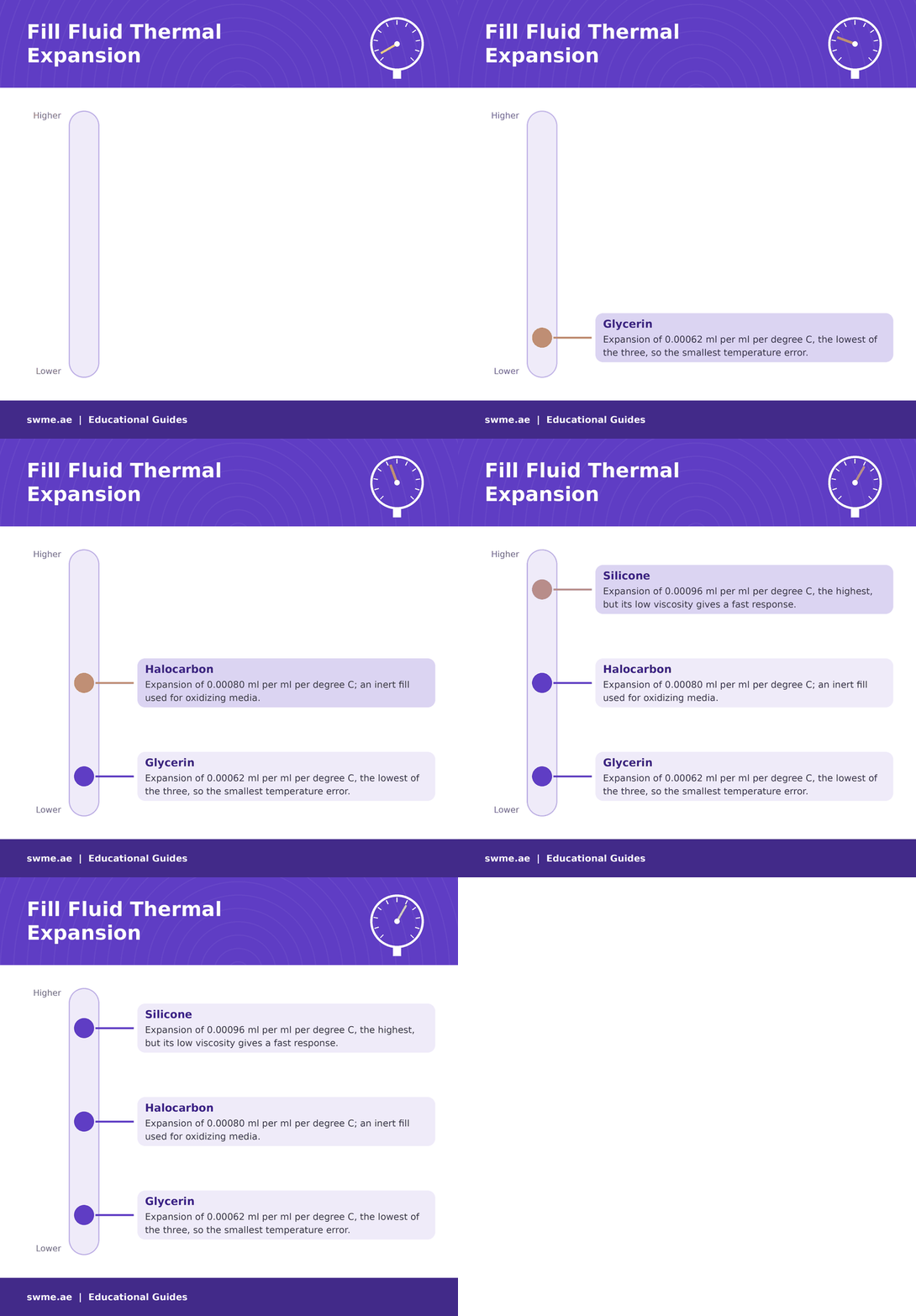
For example, the note works through a 100 psi gauge on a direct mounted seal and finds an error of about 1.25 psi. With a 5 ft flexible line at a 250 °F process, the error rises to about 2 psi, because each foot of line adds 0.8 ml of fill. Lower range gauges show larger percentage errors. You can check what that means for your loop with the instrument accuracy calculator and the thermal expansion calculator.
Did you know?
A seal that is too small can be the hidden cause of drift. REOTEMP warns that undersized diaphragms can lead to many performance issues, including sensitivity to temperature drift.
Reduces temperature error
- A fill with a low expansion coefficient
- A low spring rate diaphragm
- The shortest practical capillary
- A higher instrument range where possible
Increases temperature error
- Long capillaries exposed to sun or heat
- Low range gauges
- Overfilling, underfilling or trapped air
- Large swings in ambient temperature
Diaphragm Seal Selection Checklist
- Process conditions. Confirm pressure, temperature, viscosity, solids and any pulsation or shock.
- Wetted materials. Choose diaphragm, lower housing and gasket materials compatible with the medium.
- Diaphragm size. Make sure displacement drives the instrument through its full range at the required accuracy.
- Fill fluid. Match the fill to temperature limits and to what is safe if it leaks into the process.
- Connection. Pick threaded, flanged, clamped or inline, and decide on direct mount or capillary.
- Vacuum. REOTEMP advises contacting the factory for deep vacuum below 5 psia.
Common Mistakes to Avoid
For unit checks, the absolute and gauge pressure calculator helps, and Instrumentation Blog has more pressure measurement reading.
Frequently Asked Questions
What is a diaphragm seal used for?
It protects a pressure instrument from corrosive, viscous, abrasive, hot or toxic media by isolating it behind a flexible diaphragm.
Can a diaphragm seal be used with a transmitter?
Yes. Seals fit pressure gauges, switches and transmitters, directly or through a capillary.
Why does a sealed gauge read differently when it gets hot?
The fill fluid expands with temperature, which adds a small error. Fill choice, fill volume and capillary length decide how large it is.
