Key takeaways
- OSHA defines an oxygen deficient atmosphere as below 19.5% by volume and an enriched one as above 23.5%.
- Low oxygen gives no warning, and below 10% a single breath can cause loss of consciousness.
- Most fixed oxygen monitors alarm at 19.5%, and NIH also sets a high alarm at 23.5%.
- For oxygen deficiency monitoring, mount sensors at the height where the released gas will collect, and calibrate at least every 12 months.
Oxygen deficiency monitoring protects people in places where nitrogen, argon, CO2 or cryogenic liquids can push the oxygen out of the air. LBNL points out that these inert gases have no colour, smell or warning properties. SWME supplies fixed and portable gas detectors with oxygen sensors for plants, labs and utilities across the UAE and GCC.
In this guide
Oxygen Limits and Their Effects
Under OSHA 1910.146 for permit required confined spaces, an oxygen deficient atmosphere contains less than 19.5% oxygen by volume and an enriched atmosphere more than 23.5%. OSHA 1910.134 adds that all oxygen deficient atmospheres shall be considered immediately dangerous to life or health. Lawrence Berkeley National Laboratory gives normal air as 20.9% at sea level, while UK HSE uses 20.8%.
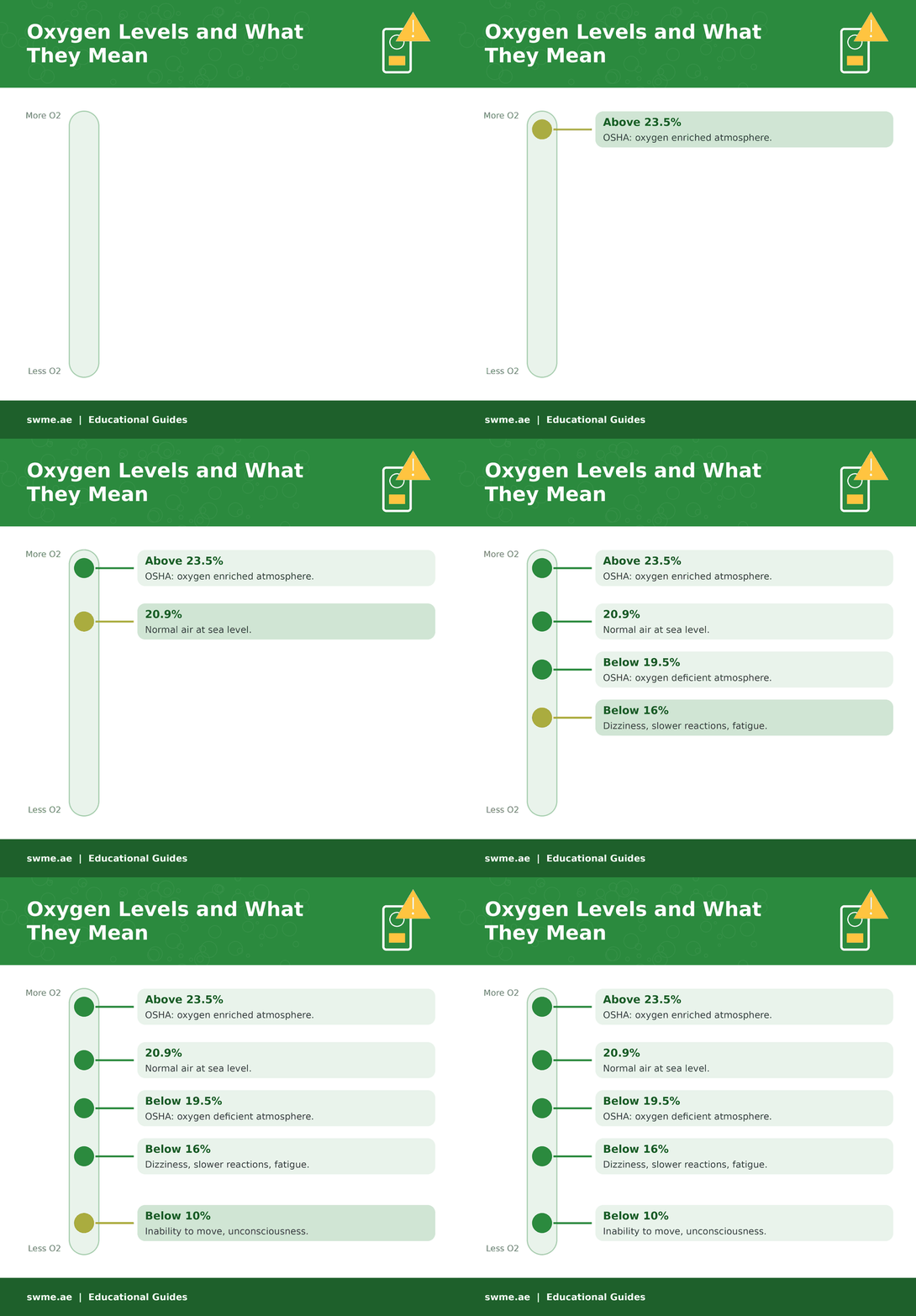
| Oxygen level | Effect (LBNL) |
|---|---|
| Below 19.5% | Mild effects similar to increased altitude |
| Below 17% | Reduced night vision, faster breathing and heartbeat, fatigue on exertion |
| Below 16% | Dizziness, increased reaction times, fatigue on mild exertion |
| Below 15% | Impaired attention, judgement and coordination |
| Below 12% | Very faulty judgement and coordination, loss of consciousness, possible permanent heart or brain damage |
| Below 10% | Inability to move, nausea, vomiting, unconsciousness |
| Below 6% | Spasmodic breathing, convulsive movements, death in 5 to 8 minutes |
Did you know?
University of Cambridge guidance warns that even a single breath at oxygen concentrations below 10% can result in loss of consciousness. The same guidance says that below 12% people can lose consciousness suddenly and without warning.
Causes of Oxygen Deficiency
OSHA's shipyard guidance calls oxygen deficient atmospheres the leading cause of confined space deaths in shipyards. NIH requires oxygen monitoring in freezer rooms and rooms where cryogenic fluids are supplied, and lists MRI and NMR rooms, tank farms and compressed gas manifold rooms. The oxygen deficiency hazard notes from LBNL explain the cryogenic case in more depth.
How Oxygen Sensors Work
Electrochemical (galvanic)
- A lead anode oxidises as oxygen reaches it
- Life is finite and set by the oxygen it sees
- Typical life about 2 years in industrial use
- Lead free versions now exist as drop in replacements
Zirconia and paramagnetic
- Zirconia cell runs at about 700 °C on the Nernst principle
- Zirconia uses ambient air as reference gas
- Paramagnetic suits percentage levels
- Paramagnetic is sensitive to vibration
An explanation of oxygen sensor chemistry from AIHA notes that lead free designs avoid lead because of EU restrictions. It also explains that capillary limited sensors read about 20.9% at any altitude, while permeation limited sensors read lower as altitude rises. Our guide to types of gas sensors compares electrochemical cells with the other sensing methods.
Operating conditions also matter for oxygen deficiency monitoring, because they shift the reading. Honeywell's note on operating conditions for oxygen sensors says a sudden pressure rise gives a brief high reading and a drop gives a low one. At 40 °C, the reading in air falls from 20.9% at 0% relative humidity to 19.4% at 100%, which is below a 19.5% alarm. Temperatures above 100 °C damage the sensor permanently.
Oxygen Deficiency Monitoring: Where to Mount Sensors
In oxygen deficiency monitoring, the right height depends on the gas that will displace the oxygen. University of Cambridge guidance gives the heights below and suggests about one detector per 50 m² at most. NIH adds that sensors should sit near likely release points.
Our gas detector placement guide covers mounting heights for toxic and flammable gases too. Where a room relies on ventilation, the air changes per hour calculator works out how many times an hour a fan replaces the air in a room.
Alarms, Calibration and Bump Tests
- Set the alarms. NIH sets alarms at the OSHA limits, below 19.5% or above 23.5%, and allows caution, warning and alarm stages.
- Calibrate the span in fresh air. MSA spans the oxygen sensor to 20.8% in fresh air during zero calibration; other makers use about 20.9%.
- Zero with nitrogen. Honeywell's VA201T procedure says the zero gas must be nitrogen.
- Bump test portables. OSHA describes a bump test as a check in which challenge gas is passed over the sensor; ISEA advises a check before each day's use.
- Calibrate fixed monitors yearly. NIH calls for calibration every 12 months or as the maker says, whichever is more frequent.
- Replace sensors on time. Plan for about 2 years of sensor life under typical conditions.
The OSHA bulletin on bump testing and calibration explains the difference in full, and our guide to bump test vs calibration shows how to apply it. To choose between a worn and a wall mounted monitor, read portable vs fixed gas detectors. More on analysers is in this collection of analytical measurement articles.
Common Mistakes to Avoid
Frequently Asked Questions
What oxygen level is unsafe?
OSHA treats anything below 19.5% by volume as oxygen deficient and above 23.5% as enriched.
How long does an oxygen sensor last?
Typical galvanic sensors last about 2 years under normal industrial conditions.
Why does my oxygen monitor read low on a humid day?
Humidity lowers the reading. Honeywell shows a drop from 20.9% to 19.4% at 40 °C and 100% relative humidity.
