Key takeaways
- A differential pressure gauge has a high and a low port and shows the difference between the two pressures on one dial.
- Piston and diaphragm designs are common at ±2% or ±5% of full scale; bellows and Bourdon designs reach ±1/2% or ±1%.
- In most DP service the working pressure on the ports is far higher than the DP range, so check the maximum working pressure first.
- Typical jobs are filter and strainer monitoring, flow across an orifice and level in open or closed tanks.
Two ordinary gauges cannot show a small difference sitting on a high line pressure. A differential pressure gauge takes both pressures into one instrument and shows only the difference. SWME supplies differential pressure gauges and gauge accessories for plants across the UAE and GCC.
In this guide
How a Differential Pressure Gauge Works
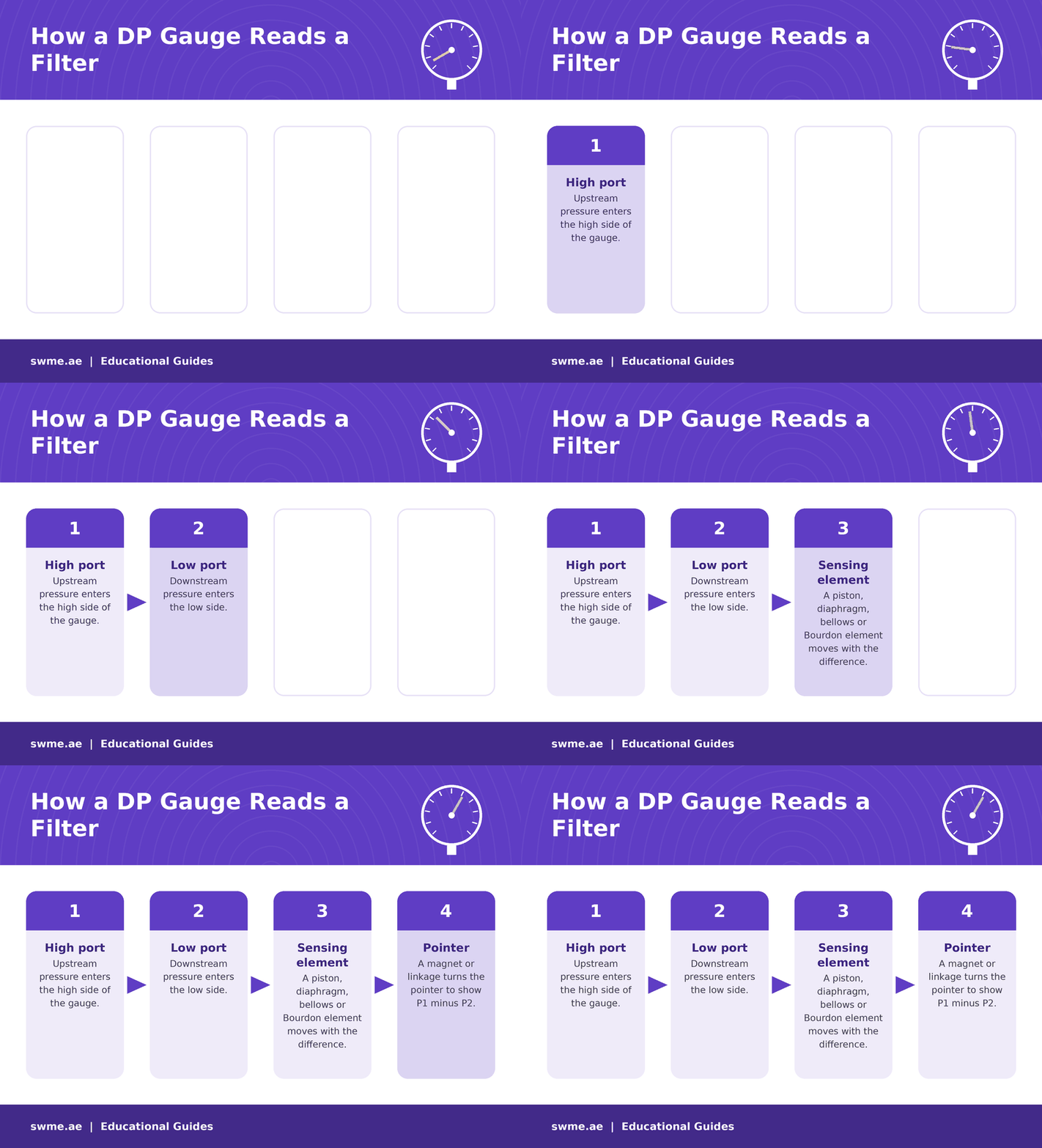
The gauge has a high pressure port and a low pressure port. The sensing element sits between them and moves with the difference, and a magnet or linkage turns the pointer. For the difference between gauge, absolute and DP readings, see our guide to gauge vs absolute vs differential pressure.
Sensing Designs
The Midwest Instrument selection guide and NOSHOK describe four main designs.
| Design | How it senses | Suits | Stated accuracy |
|---|---|---|---|
| Piston | A floating piston and magnet move in a bore against a calibrated spring; a rotary magnet outside drives the pointer | Liquids. A little liquid bypasses from high to low port, which Midwest says is often too much for gas | ±2% or ±5% full scale |
| Diaphragm | An elastomer diaphragm moves against a range spring and carries an internal magnet | Dissimilar fluids, air, gases and liquids with a high solids content, because the ports are fully isolated | ±2% or ±5% full scale |
| Bellows | DP acts on a bellows and linkage that drive the pointer | Clean service where accuracy matters | ±1/2% or ±1% full scale |
| Bourdon | A Bourdon tube sits inside a pressure chamber and reads the difference between inside and outside, coupled by magnet | High working pressures | ±1/2% or ±1% full scale |
WIKA leaves bellows out of its DP range because bellows are susceptible to pressure spikes, and recommends diaphragm types instead. Where a 4 to 20 mA signal is needed rather than a local dial, use a differential pressure transmitter.
Working Pressure and Range
WIKA's introduction to DP measurement notes that in almost every DP application the working pressure is much higher than the DP range, and the maximum working pressure is very critical. Midwest protects its bellows and Bourdon units against overrange in either direction up to the rated working pressure, with a relief valve that opens to equalise the two sides.
At a glance
Did you know?
WIKA gives a simple example: 10 inches of water is 0.36 psi. Two standard gauges reading about 100 psi could not show that difference, but one DP gauge can.
Applications
For level work the hydrostatic pressure calculator gives the DP for a liquid height, and the DP flow square root calculator converts a reading to flow. More background is in the Instrumentation Blog pressure section.
Selection Checklist
- DP range. Size the dial for the difference you expect, not the line pressure.
- Maximum working pressure. Confirm the rating covers the highest line pressure and any one sided overpressure.
- Fluid. Piston for liquids; diaphragm for gas, mixed or dirty media; bellows or Bourdon for best accuracy.
- Wetted materials. Corrosive media may need stainless steel. Ask about NACE or oxygen service if required.
- Connections. WIKA says filters typically use inline end connections, low air pressures use hose barbs, and level often uses four ports with 1/4 inch NPT female threads.
- Options. Switches, output signals and a valve manifold with shutoff and an equalising bypass. See manifolds and fittings.
Common Mistakes to Avoid
For a DP alarm without a dial, see differential pressure switches and our guide on what a pressure switch is.
Frequently Asked Questions
What does a differential pressure gauge measure?
The difference between the pressure at its high port and its low port, shown on one dial.
Which design suits gas?
A diaphragm type, because its ports are fully isolated. Piston types allow a small bypass that can be too large for gas.
Why is working pressure so important?
The ports often see a line pressure far above the DP range, and the gauge must withstand it on either side.
