Key takeaways
- Snubbers suppress pressure pulses and peaks, which WIKA names as common reasons for gauge failure.
- A siphon holds condensate between steam and the gauge. Ashcroft puts a gauge's operating rating at 200 to 250 °F (93 to 121 °C).
- Fill a siphon with water before you fit it.
- A gauge valve or block and bleed valve lets you isolate the gauge and take it off without shutting the line.
WIKA names pressure pulses and peaks as common reasons for gauge failure, and live steam and service access bring their own problems. Each is handled by one of three pressure gauge accessories: a snubber, a siphon or a gauge valve. SWME supplies gauge accessories and pressure gauges for plants across the UAE and GCC.
In this guide
How Pressure Gauge Accessories Work
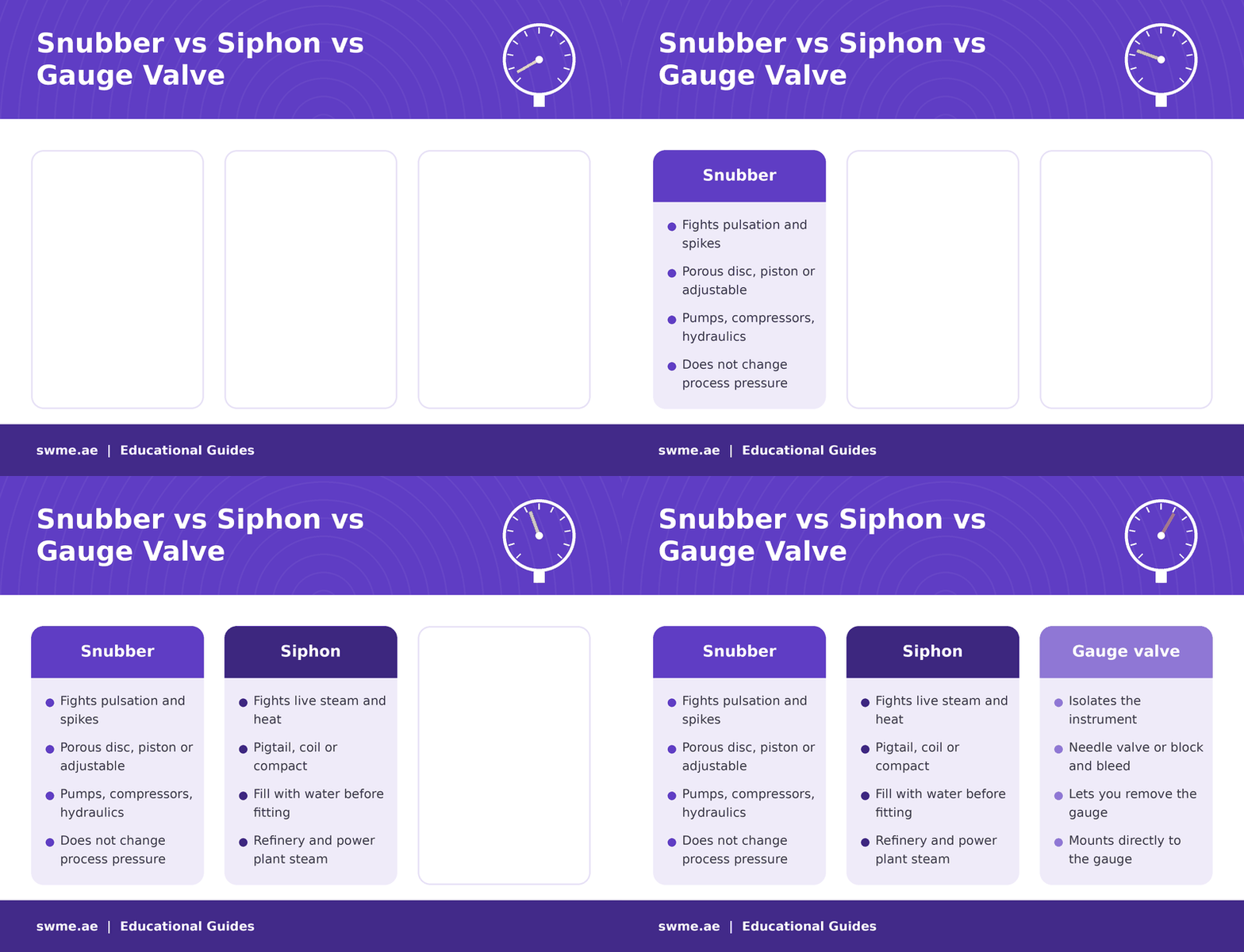
Pressure gauge accessories each deal with one problem. A snubber slows the pressure change reaching the gauge, a siphon puts a column of cool water between the gauge and hot media, and a gauge valve shuts the gauge off from the line. The diagram below shows all three stacked on one steam tapping.
Snubbers and Throttle Screws
WIKA's guide to dynamic load cycles says they often come from pump surges and show up as a fluctuating pointer, and that they eventually shorten the gauge's service life. Its 910.12 snubber page lists reciprocating pumps, compressors, hydraulic presses and fluid power systems as typical duties. As Tameson notes, a snubber does not change the process pressure itself.
| Type | How it works | Notes from the sources |
|---|---|---|
| Porous disc | A fixed mesh disc restricts flow to the gauge | Cheapest type. It can clog, is cleaned with solvent from the gauge side and cannot be tuned (Tameson) |
| Piston | A free piston moves against the orifice when pressure rises quickly | Self cleaning. Tuned by changing the piston; WIKA supplies five pistons |
| Adjustable | A needle valve restricts flow ahead of a piston snubber | Some have a tight shutoff so the gauge can be removed (Tameson) |
| Throttle screw | A restrictor that fits completely inside the gauge socket | Ashcroft calls it economical; threaded versions come out for cleaning |
At a glance
Tameson adds that a liquid filled gauge can do the same job as a snubber at a higher cost, and the two can be combined. For pressure surges in the line itself, the water hammer calculator estimates the pressure rise.
Siphons for Steam
A siphon is a looped tube between the line and the gauge. In Ashcroft's explanation, steam cools and condenses in the loop, so only cooler liquid reaches the instrument. Gauges are commonly rated for 200 to 250 °F (93 to 121 °C), and Ashcroft warns that even low temperature steam can go past that.
Did you know?
Boshart gives a rough figure of about 75 °F of cooling for each 12 inch section of 1/2 inch pipe, and says the real figure depends on the process. Its siphon note also lists pressure switches, controllers and recorders as instruments a siphon protects.
Gauge Valves and Block and Bleed
Ashcroft describes a gauge valve as mounting directly to the instrument to isolate it for protection or removal. A two valve block and bleed adds a vent so you can release trapped pressure before you unscrew the gauge. For differential pressure instruments, three and five valve manifolds isolate, equalise and bleed. See SWME manifolds and fittings.
Single gauge valve
- Isolates the gauge
- Mounts directly to the instrument
- Needle valves also throttle
Block and bleed
- Isolates the gauge
- Adds a bleed for the media
- Mounts directly to the instrument
Selection Checklist
- Problem. Pulsation calls for a snubber, steam or hot media for a siphon, and removal under pressure for a valve.
- Pressure rating. Tameson warns that a lower rated snubber on a high pressure system will be a problem.
- Temperature. Check the snubber's media limit, and fit a siphon wherever steam can reach the gauge.
- Threads. Match the line and the gauge connection, for example 1/2 NPT.
- Material. Use stainless steel where brass is not suitable.
- Gauge choice. Read our pressure gauge selection guide, and for corrosive or viscous media see diaphragm seals.
Common Mistakes to Avoid
More background is in the Instrumentation Blog pressure section, and switches can use the same pressure gauge accessories; see pressure switches.
Frequently Asked Questions
Does a snubber change the pressure reading?
No. Tameson says it damps spikes and pulses without altering the process pressure.
Do I need a siphon on every steam gauge?
Ashcroft says siphons should be used wherever instruments need protecting from live steam.
Can a liquid filled gauge replace a snubber?
Tameson says it can serve the same purpose at a higher cost, and the two can be used together.
