Key takeaways
- An analog gauge turns pressure into pointer movement through a Bourdon tube, diaphragm or capsule and needs no power.
- A digital gauge reads a piezoresistive sensor through a microprocessor and shows the value on a display, so it needs batteries or another supply.
- Analog accuracy is stated as ASME B40.100 grades or EN 837 classes, as a percentage of span. The digital gauges below are rated from 0.25% to 0.01% of full scale.
- Digital gauges add peak hold, tare and logging; liquid filled analog gauges cope well with vibration.
The choice between digital vs analog pressure gauges comes down to how each one measures, how closely you need to read it and whether it can run on a battery where it is fitted. SWME supplies mechanical pressure gauges and digital pressure gauges for plants across the UAE and GCC.
In this guide
How an Analog Pressure Gauge Works
WIKA describes the Bourdon tube as a C shaped, bent tube with an oval cross section. Pressure pushes the cross section toward a circle, the tube straightens a little, and its free end moves by around two or three millimetres. A link, sector and pinion turn that small movement into rotation of the pointer. WIKA uses C tubes up to 60 bar and helical or spiral tubes up to about 7,000 bar. See the Bourdon tube operating principle.
For low pressures, WIKA diaphragm gauges use a thin corrugated metal disc and measure down to 10 in.H2O (25 mbar). Capsule gauges, made of two ridged plates joined together, are best suited to dry gases. The diaphragm pressure gauge explainer compares the two elements.
How a Digital Pressure Gauge Works
The comparison of digital and analog gauge calibration says digital gauges generally have compact piezoresistive sensors. Tameson explains that pressure deflects a diaphragm, which changes the electrical resistance of the material and creates a voltage difference. An internal microprocessor then turns that voltage into a pressure reading on the display. Piezoresistive sensors are used most because they are robust and cheaper than capacitive sensors.
Accuracy Grades and Classes
The ASME accuracy grades are a percentage of the gauge span. Whole scale grades are 4A at ±0.1%, 3A at ±0.25%, 2A at ±0.5% and 1A at ±1%. Grades A and B are split: Grade A allows ±2% in the lower and upper quarter and ±1% in the middle half, and Grade B allows ±3% and ±2%.
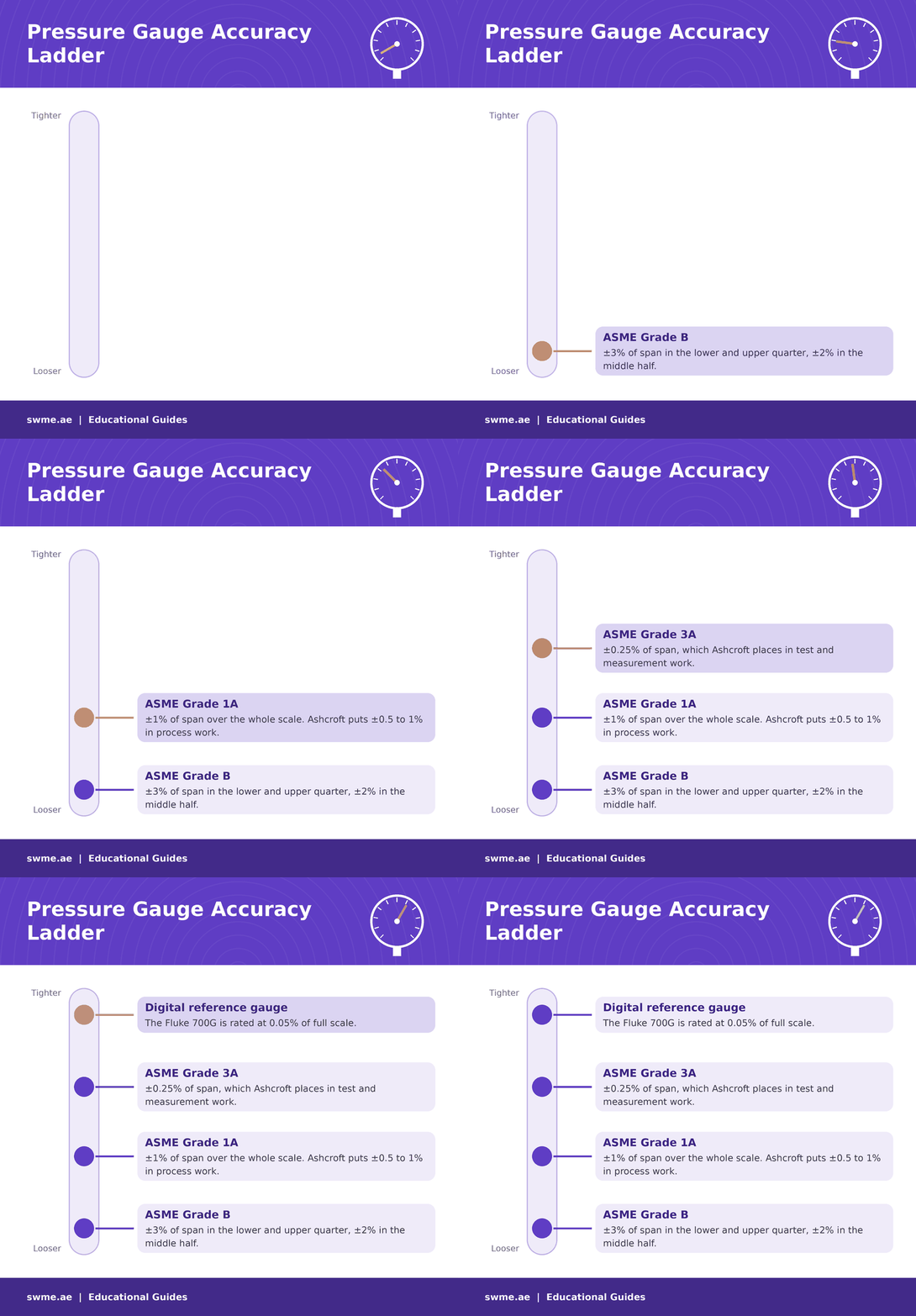
EN 837 uses classes instead. WIKA lists 4% or 2.5% for plastic cases, 1.6% or 1.0% for chrome or stainless steel cases, and 0.6%, 0.25% or 0.1% for test gauges. For example, class 1.0 on a 0 to 100 bar gauge allows 1 bar of error anywhere on the scale. Digital gauges are rated the same way, against full scale or reading:
| Digital gauge | Rated accuracy | Power and battery life |
|---|---|---|
| Dwyer DPG 100 | ±0.25% of full scale | 2 AAA, about 2000 hours on average |
| Crystal XP2i | 0.1% of reading | Not stated in our source |
| Fluke 700G | 0.05% of full scale | 3 AA, 1,500 hours with no backlight |
| Additel 681A | 0.01%, 0.02%, 0.05% FS or 0.1% of reading | 3 AA, 4000 hours at 3 readings a second |
The instrument accuracy calculator turns a percentage of span or full scale into the error at your working pressure.
Power, Resolution and Features
Fluke says that on a dial you will probably see a different value when you look straight on than from the side, and a fine pointer tip or a mirror band reduces it. Small increments are also harder to tell apart on a dial. A display removes both problems: the Fluke 700G04 resolves 0.001 psi.
The trade off is power. Digital gauges run from a wall plug, a USB port or batteries, and Fluke warns that a low battery could affect operation or accuracy. The Dwyer DPG has keys for backlight, peak and valley, tare and unit change. The Additel 681A logs up to 10,000,000 records, and the Crystal XP2i captures the high or low peak for relief valve testing.
Did you know?
A liquid filled analog gauge is only filled to 80 to 90%. WIKA explains that the filling damps pressure peaks, shocks and vibration, and that without it the pointer can swing over 180° at resonance. The guide to gauge filling liquids says when silicone oil replaces glycerine.
Vibration, Temperature and Hazardous Areas
Analog gauge
- Glycerine and water filling suits most ambient temperatures
- WIKA uses silicone oil above +60 °C or below minus 20 °C
- WIKA 232.53 drifts ±0.4% of span for every 10 K away from 20 °C
Digital gauge
- Fluke notes accuracy may depend on local temperature
- Fluke 700G is compensated from 0 to 50 °C
- Fluke 700G carries CSA Class 1 Div 2 and ATEX Ex ic approval
- Additel ADT681AEx is rated Ex ia IIC T4 Ga
To protect either type from surges, see our guide to snubbers, siphons and gauge valves and the gauge accessories we stock. Our blog on pressure measurement in hazardous areas covers approvals in more detail.
Choosing Between Digital vs Analog Pressure Gauges
- Set the range first. Ashcroft says operating pressure should sit between 25% and 75% of scale, with the range about twice the operating pressure. With pulsation, keep the maximum under 50% of full scale.
- Match the accuracy to the job. Ashcroft puts ±0.5 to 1% of span in process work and ±0.25% or better in test and measurement.
- Check the service. Vibration and pulsation favour a liquid filled dial or a damping accessory.
- Check the area classification. A digital gauge in a hazardous area needs a matching approval.
- Weigh cost. Fluke calls analog gauges relatively inexpensive and says digital gauges may cost more than an equivalent analog gauge.
Our guide on how to select a pressure gauge covers dial size, case and connection. When a gauge needs checking, the test and calibration equipment we supply includes reference gauges, and the calibration articles walk through the procedure.
Common Mistakes to Avoid
Frequently Asked Questions
Is a digital pressure gauge always more accurate?
No. A 3A or 4A test gauge reaches ±0.25% or ±0.1% of span, as good as or better than a 0.25% full scale digital gauge.
Can a digital gauge be used in a hazardous area?
Yes, if it carries the right approval, for example the Additel ADT681AEx rated Ex ia IIC T4 Ga.
Why are some analog gauges filled with liquid?
The filling damps pressure peaks, shocks and vibration so the pointer stays readable.
