Key takeaways
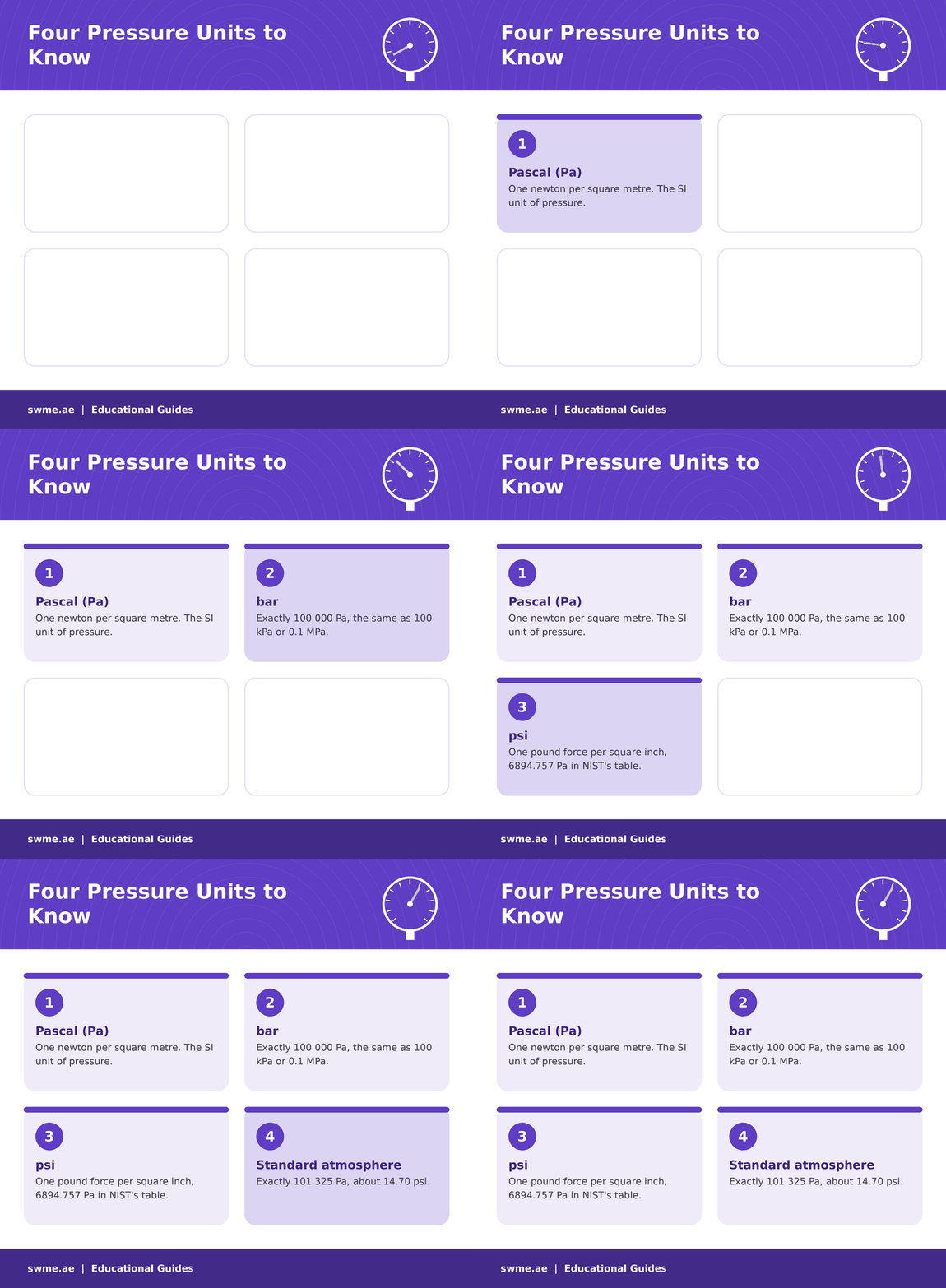
- The pascal (one newton per square metre) is the SI unit; bar, psi, atm and the liquid column units are all defined against it.
- NIST marks the bar (100 000 Pa), the standard atmosphere (101 325 Pa) and the kgf/cm² (98 066.5 Pa) as exact conversion factors.
- Inches of water and millimetres of mercury depend on the liquid's reference temperature, so check which basis a datasheet uses.
- Convert through pascals: multiply by the factor for the unit you have, then divide by the factor for the unit you want.
A pressure gauge dial in bar, a pump curve in psi and a draft gauge in inches of water may all show up in the same plant. Getting pressure units right matters when you specify a range on a purchase order. SWME supplies pressure gauges and pressure transmitters with dials and ranges in the unit your site uses.
In this guide
The Pascal and the SI System
NIST Special Publication 811 defines the pascal as one newton per square metre. It is a small unit, so plants use kilopascals and megapascals: 1 kPa is 1000 Pa and 1 MPa is 1 000 000 Pa. The same publication lists the bar (10⁵ Pa) under units in use temporarily with the SI. It says these units should not be introduced where they are not already used.
The NIST guide to SI units also has rules for writing values: a space between number and symbol (150 kPa), no plural s on a symbol, and no full stop after it except at the end of a sentence.
Common Pressure Units
| Unit | Value in pascals | Exact? | Where you see it |
|---|---|---|---|
| bar | 100 000 | Yes | Gauges and transmitters in Europe, the Middle East and Asia |
| millibar (mbar) | 100 | Yes, by definition of the bar | Low pressure, draft and weather |
| psi (lbf/in²) | 6894.757 | No | US equipment, pumps, compressors |
| standard atmosphere (atm) | 101 325 | Yes | Reference conditions, vacuum |
| kgf/cm² | 98 066.5 | Yes | Older gauges and Asian datasheets |
| torr (mm Hg at 0 °C) | 133.3224 | No | Vacuum |
| inch of mercury (inHg) | 3386.389 | No | Vacuum gauges, barometers |
| inch of water (inH₂O) | 249.0889 | No | Draft, filters, HVAC and low DP |
The values come from the NIST pressure unit conversion table, and NIST SP 811 marks the exact ones with an asterisk. The Omega pressure conversion data gives the same factors to four figures, for example 1 psi = 703.1 mm H₂O.
How to Convert Pressure Units
Every factor in the table is a value in pascals, so pascals work as a hub. Multiply your reading by the factor for its unit to get pascals, then divide by the factor for the unit you want.
Worked examples
To see what a pressure means as a column of liquid, the pressure to head calculator works out the height of liquid that a given pressure supports, which helps when you set a level transmitter range. The pressure calculator collection covers other unit and range sums.
Did you know?
A kgf/cm² is 0.980665 bar, so the two are about 2% apart. At the top of a 0 to 16 range the gap is about 0.31 bar, so a gauge marked in one cannot stand in for the other.
Liquid Column Units
Inches of water and millimetres of mercury describe pressure as the height of a liquid column, and the liquid's density changes with temperature. Omega labels its factors "inch of water at 4 °C" and "mm of mercury at 0 °C". NIST SP 811 lists the inch of water at 39.2 °F (249.082 Pa) and at 60 °F (248.84 Pa) as separate units. The difference is under 0.1%, which matters only for precise low pressure work such as calibrating a draft gauge.
The hydrostatic pressure formula shows where these units come from: pressure equals density times gravity times height. The manometer calculator gives the pressure difference for a manometer reading in your fluid.
Specifying Units on Instruments
- Say gauge or absolute. psi alone does not say whether the reading starts from atmosphere or from vacuum. Omega's altitude table gives 14.70 psia at sea level. Our guide to gauge, absolute and differential pressure explains the three references.
- Use one unit per site. Match the unit already on the P&ID and in the DCS so operators do not convert in their heads.
- Ask for dual scales where needed. A dial in bar and psi helps when equipment comes from different countries.
- State the reference temperature for water columns. Write inH₂O at 4 °C or at 60 °F when the range is small.
- Check the transmitter's engineering units. The 4 to 20 mA range must be set in the same unit as the DCS scaling. The absolute and gauge pressure calculator converts between the two references when a datasheet uses the other one.
For help choosing a range, see how to select a pressure gauge. SWME also supplies digital pressure gauges alongside dial gauges.
Common Mistakes to Avoid
Frequently Asked Questions
Is bar an SI unit?
No. NIST SP 811 lists it as a unit in use temporarily with the SI. It equals exactly 100 000 Pa.
How many psi are in one bar?
100 000 ÷ 6894.757 gives 14.504 psi per bar.
Why do inches of water have more than one value?
The value depends on the water temperature used as the reference, such as 4 °C (39.2 °F) or 60 °F.
